
Answering Service for Contractors in 2026: A Buyer's Guide and Honest Comparison
A plain guide to contractor answering services: traditional human services vs standalone AI receptionists vs a platform that books the job. What each costs, where after-hours calls leak, and how to choose.

Jeremy Edgar
Published Jul 7, 2026
Last updated Oct 3, 2026
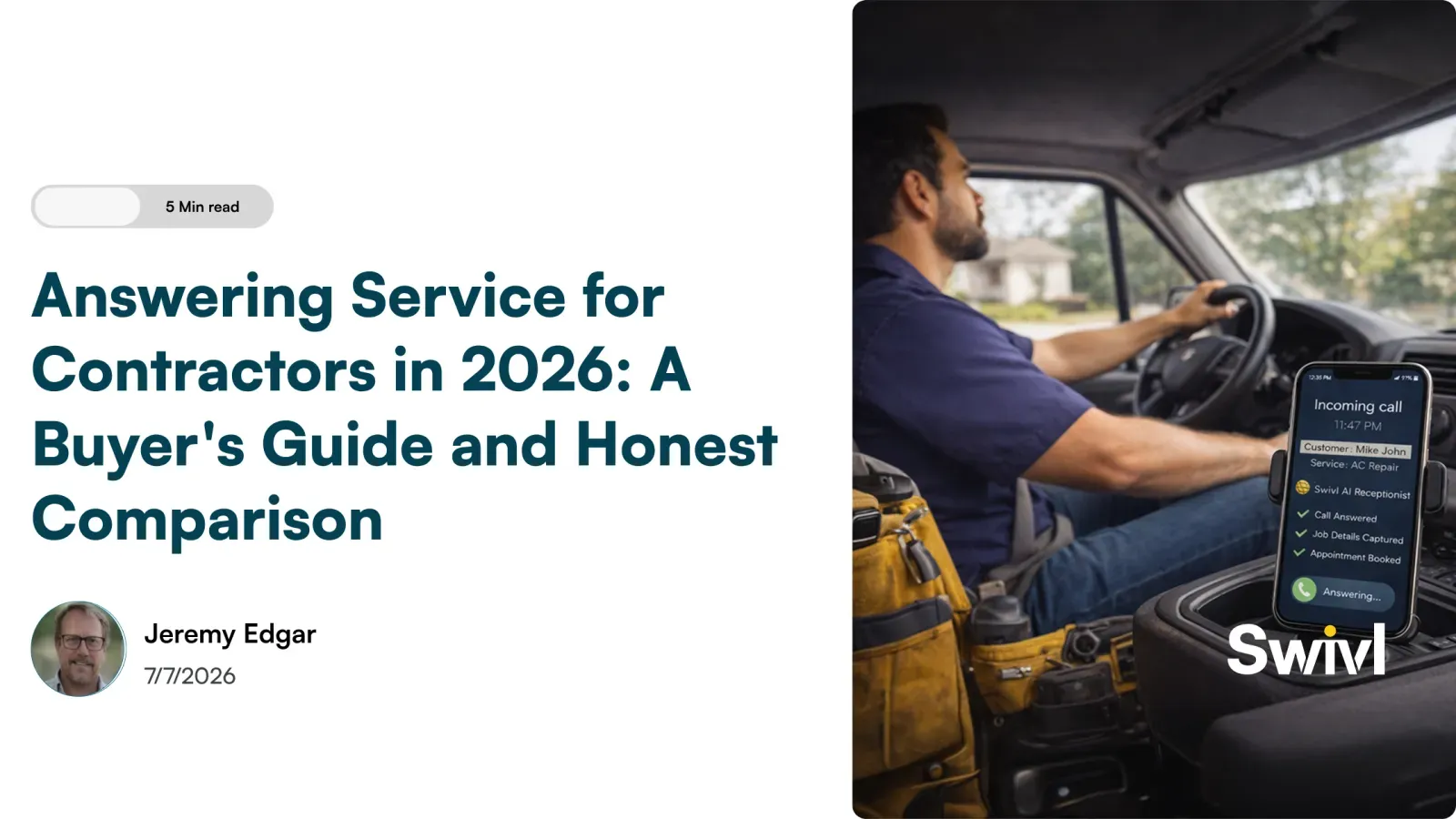
Table of Contents
Share this article
The most expensive thing that happens in a trades business happens when nobody's looking. You're flat on your back under a sink, on a ladder, or already home with your boots off, and the phone rings. It goes to voicemail. And the caller, a homeowner with water spreading across the kitchen floor, does what almost everyone does with a voicemail box: they hang up and call the next name on the list.
A large share of first-time callers who hit voicemail never call back and never leave a message. For a plumber, an HVAC shop, or an electrician, every one of those is a job that was yours to lose, and you lost it to a ringtone. That's the problem an answering service for contractors is supposed to solve. This guide covers what these services actually do, an honest comparison of the main options in 2026 (traditional human services, standalone AI receptionists, and platforms that book the job for you), where the money leaks (after-hours and overflow), and how to pick one that fills your schedule instead of just taking messages.
What an answering service does, and the two kinds you can buy
At its simplest, an answering service catches the calls you can't. When your line is busy or unanswered, the call rolls to someone (or something) that picks up, handles the caller, and gets you the details. For a service business, that "someone" comes in two very different flavors, and the difference is the whole story.
The traditional human answering service. A call center, often generic, sometimes offshore, answers in your company's name, reads from a short script you gave them, takes down the caller's name, number, and problem, and relays it to you by text or email. You call the customer back. It's better than voicemail. But it has three built-in leaks: the operator doesn't know your trade or your prices, so they can't answer a single real question; there's a callback delay, during which your customer may already be booking someone else; and it's usually billed per call or per minute, so a busy month or a chatty caller runs up the bill fast.
The modern AI receptionist. Instead of a person taking a message, an AI voice agent trained on your business answers instantly, 24/7, on the first ring. It knows your services and service area, answers the common questions ("do you do tankless?", "what's your service-call fee?"), and, this is the part that changes your revenue, it books the job straight into your schedule and texts you and the crew the details. No message to return, no callback race: the job is on the calendar before you're out from under the sink.
Both are "answering services." Only one of them actually captures the work.
The main answering services for contractors in 2026, compared
Search "answering service for contractors" and you'll get a wall of options that look interchangeable but split into three real groups. The honest way to choose is to know which group you're in and what each one actually does with the call. No two shops price these the same way, so treat the pricing model below as the thing to compare, and confirm current numbers on each provider's own page before you sign.
Group 1: traditional human answering services (Ruby, AnswerConnect, MAP Communications, PATLive, ReceptionHQ, AnswerHero, Posh). Real people answer in your name, take a message, capture the lead, and relay it to you. The upside is a human voice on every call and the ability to handle an odd, complex conversation. The downsides are the three leaks above: the operator can't answer trade questions, you still have to call back to book, and pricing is almost always per minute or per call, so your bill spikes in exactly the busy months when you're getting the most calls. Premium live plans commonly run into the hundreds of dollars a month once your call volume climbs.
Group 2: standalone AI receptionists (Dapta, Smith.ai's AI tier, Clara, OnCrew, and a fast-growing field of others). An AI voice agent answers 24/7, qualifies the caller, and, on the better ones, books an appointment. This is a genuine step up: it answers on the first ring at 2 a.m., it never puts a caller on hold, and it usually prices as a flat monthly plan instead of per minute, so a busy month doesn't punish you. The catch is that a standalone tool lives in its own app. The booking lands in its calendar, and you still have to get it onto the schedule your techs actually work from, into the customer record, and out to the crew. You've fixed the answering problem and created a re-typing problem.
Group 3: a field-service platform with the AI receptionist built in (Swivl). The AI receptionist is the same idea as Group 2, but it's part of the same system that runs your scheduling, customer records, and payments. So when a call is booked, it is a job on your dispatch board, with the customer record created and you and the crew texted, with nothing to re-type. Because it's bundled into a platform you already need, you're not paying a separate per-minute answering bill on top of your field software. And on the pricing model that matters most to a growing shop, Swivl charges unlimited users on every plan instead of a per-seat fee, so adding a dispatcher or a third tech never raises the price of your call coverage.
The short version: a human service stops calls from vanishing, a standalone AI receptionist books them, and a platform with the receptionist built in books them and lands the job where the work actually happens. Match the group to how much of the "answered to booked to done" chain you want handled for you.
Where the money really leaks: after-hours and overflow
Owners tend to picture missed calls as the odd one that slips through during a busy afternoon. The real damage is concentrated in two windows.
After-hours. An after-hours answering service matters because emergencies don't keep business hours. The burst pipe at 9 p.m., the no-heat call on a Sunday in January, the dead panel on a holiday weekend: these are your highest-value, highest-intent calls, and they land exactly when your office is dark. A homeowner in an emergency will call three numbers in five minutes and go with whoever answers. If that's a voicemail box, you were never in the running.
Overflow. The other leak is the call that comes in while you're already on the phone, or while your one office person stepped away. Every trades shop has a daily window where two calls arrive at once and one drops. Overflow coverage catches the second call so a busy day doesn't quietly cost you jobs.
Here's the math that makes it real. Say your average job is worth $300, and a busy shop misses just two catchable calls a day (one after-hours, one overflow). If even half would have booked, that's one lost job a day: roughly $1,800 a week, on the order of $90,000 a year, walking to a competitor because the phone wasn't answered. Against numbers like that, the question isn't whether to cover your calls. It's which kind of coverage turns the call into a booked job.
What to look for in an answering service for the trades
Not all coverage is equal. If you're shopping, judge it against what a service business actually needs:
- Speed to answer. First ring, every time, with no hold. In an emergency, second place is last place.
- 24/7, including nights, weekends, and holidays. That's when your best calls come in. Business-hours-only coverage misses the point.
- It knows your business. Your services, your service area, your basic pricing and call-out fee. An operator who can't answer "do you cover my zip code?" loses the caller.
- It books, not just takes a message. The single biggest upgrade you can make is coverage that puts the job on your schedule instead of handing you a callback to chase.
- Predictable pricing. Per-minute and per-call plans punish you for being busy. Look for pricing that doesn't spike in your best months.
- It plugs into the rest of your system. A booked call is only useful if it lands on the same schedule your techs already work from, with you and the crew texted the details the moment it's booked. Coverage that lives in a separate silo just creates double entry.
That last point is where a standalone answering service and an all-in-one platform part ways. A separate call center hands you a note; you still have to get it onto your dispatch board, into the customer record, and out to the tech. When call coverage is built into the same system that runs your scheduling, customer history, and invoicing, the booked call is the job, with no re-typing and no dropped hand-offs.
The AI receptionist difference: it books the job
The reason the AI receptionist has taken over this category so fast is simple: it closes the gap between "someone answered" and "the job is booked."
A human message service is a relay. A caller talks to a stranger who writes down what they said and passes it along; then you call back, hope they still answer, and then book the job, often hours later, sometimes into the next day, frequently after they've already hired someone else. Every step is a place to lose the customer.
An AI receptionist collapses all of that into the original call. It answers on the first ring, has a natural back-and-forth with the homeowner, pulls up your real availability, offers a time, and confirms. The customer hangs up already on your calendar. It works identically at 2 p.m. on a Tuesday and 2 a.m. on a Sunday, and because it answers for one business it can be genuinely helpful instead of reading a generic script. For a shop where the owner is also the lead tech, it's a front-desk hire you didn't have to make.
That's the shift worth understanding before you buy: you're not choosing between "voicemail" and "someone takes a message." The real choice in 2026 is between a message you have to chase and a job that's already booked.
A worked example: one missed Saturday call
Meet Ray, who runs a two-truck plumbing shop. It's Saturday, 8:40 a.m. Ray is elbow-deep in a repipe across town. His phone rings: a homeowner whose water heater let go overnight, standing in a wet garage, ready to pay whatever it takes to get someone out today.
Without call coverage. The call rings out and hits voicemail. The homeowner doesn't leave a message, they're already dialing the next plumber from the search results. By the time Ray checks his phone at lunch and sees the missed call, the job is done, paid, and gone to a competitor. A same-day water-heater replacement Ray would have priced around $2,200, plus the repeat business and referrals of a customer who'd have been grateful for life, evaporated because a phone rang while his hands were full. Multiply that by the emergency calls that land every weekend and every evening, and it's the single biggest hole in the business.
With an AI receptionist. The same call rings once and is answered, in Ray's company name, by a voice agent that knows he does water-heater replacements, covers that zip code, and has a slot that afternoon. It reassures the homeowner, gathers the address and the make of the unit, offers a 1 p.m. window, and books it. Ray's phone buzzes with the full job on his schedule before he's even tightened the next fitting. He finishes the repipe, drives straight to the water-heater call, and closes a $2,200 job he never would have heard about. Nothing about the work changed, only whether the phone turned into a booking.
Here's the chain a real answering service should close, end to end:
Call comes in (any hour), answered on the first ring in your name, caller's questions answered, job booked into an open slot, you and the crew texted the details, the job lands on the same schedule your techs already work from.
Every arrow in that chain is a place a voicemail box, or a message service that just relays a note, normally drops the ball. Closing them is the entire job of call coverage.
How to choose (a quick buyer's checklist)
- Decide what "answered" has to mean for you. If a returned message hours later is fine, a human message service (Group 1) will do. If you want the job booked on the call, you need an AI receptionist (Group 2 or 3). Be honest about how many callbacks you actually chase down in time.
- Test it after hours and on a weekend. Call your own number at 9 p.m. on a Saturday during a trial. That's when your money calls come in, so make sure the coverage shines exactly then.
- Ask what it knows about your business. Can it answer "do you service my area?" and "what's the call-out fee?" Coverage that can't answer a basic question can't book a job.
- Watch the pricing model. Per-minute and per-call plans spike in your busiest months. Prefer predictable pricing, and if it's bundled into a platform you already need, better still.
- Make sure booked calls land in one place. The best outcome is call coverage built into the same system that runs your scheduling, customer records, and invoicing, so a booked call becomes a job with zero re-typing, not a note in a separate app.
Get those right and you'll stop paying for coverage that just takes messages, and start paying for coverage that fills your schedule.
The bottom line
For a trades business, the phone is the business, and the calls you can't answer are the ones most likely to become jobs, because they're the emergencies and the ready-to-buy homeowners who won't wait. A traditional answering service stops those calls from vanishing into voicemail, which is a real improvement. A standalone AI receptionist goes further and books the job. But in 2026 you can do best of all: an AI receptionist that answers instantly around the clock, knows your business, books the job onto your schedule before the caller hangs up, and does it inside the same system that runs the rest of your shop.
Swivl is built for exactly this: plumbing, HVAC, electrical, and cleaning shops that can't afford to miss a call. Its AI receptionist answers every call you can't, day or night, books the job straight into your schedule, and texts your crew the details, all inside the same system that runs your dispatch board, customer history, and payments, with unlimited users on every plan so growing your team never grows your bill.
Start free, no credit card required and let your next after-hours call turn into a booked job instead of a missed one.
Related reading: field service management software for small business, the field service features that actually matter, and how job scheduling software tightens your dispatch board. Run a specific trade? See HVAC answering service and plumber answering service. Comparing tools? See Housecall Pro alternatives and Swivl pricing.
Ready to transform your business?Transform your business
Join thousands of contractors already growing with Swivl's AI-powered platform.