
Employees, 1099s, or Subcontractors? A Field Service Owner's Guide to Worker Classification
When you add someone to Swivl, are they an employee, a 1099, or a subcontractor? The categories aren’t interchangeable — they change how you pay, how Swivl tracks cost, and what you owe at your year-end workers comp audit. Here’s how to tell them apart and how to set each up correctly.
-2.webp)
Rob Heller
Published Apr 29, 2026
Last updated Jun 1, 2026
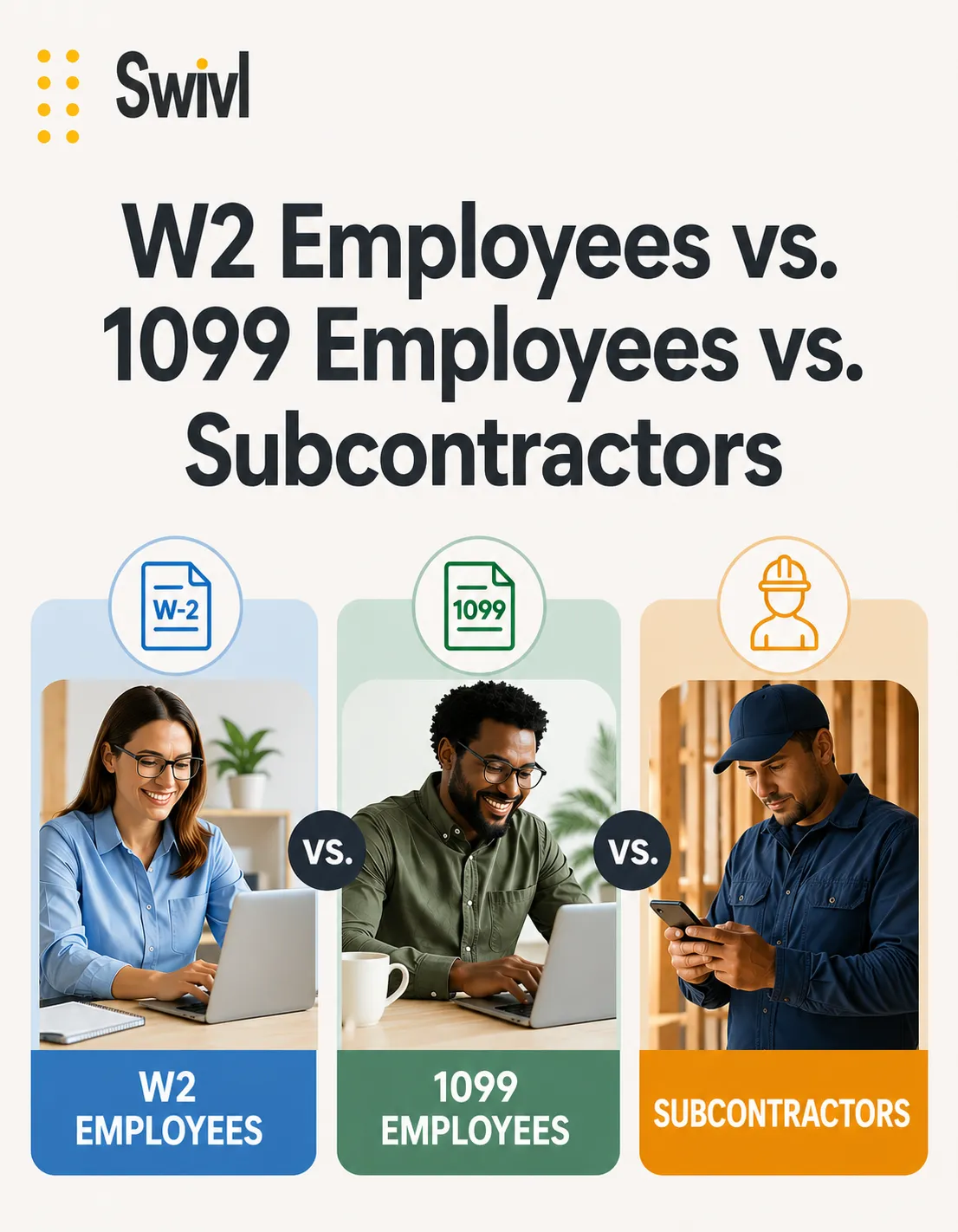
Table of Contents
Share this article
Why Worker Classification Matters for Field Service Businesses
One of the most consequential decisions a home service business makes is how it classifies the people doing the work. Employees, 1099 contractors, and subcontractors all have different legal relationships with your business, different cost structures, and different implications for taxes, insurance, and liability. Getting this wrong is not just an administrative inconvenience — it can result in back taxes, penalties, and legal exposure.
The good news is that the distinction between these classifications is relatively clear once you understand the criteria. This guide covers the key differences, helps you decide which type of worker fits your needs, and explains how to reflect those relationships in your Swivl account.
Employees: When You Need Control and Consistency
An employee is someone who works under your direction and control. You set their hours, tell them which jobs to take, provide equipment, and manage how the work is done. In return, you are responsible for withholding payroll taxes, paying the employer's share of Social Security and Medicare, providing workers' compensation insurance, and complying with labor law requirements around overtime, breaks, and leave.
For most home service businesses with a stable crew of technicians who work regular hours, employees are the right classification. The added administrative and tax burden is offset by the ability to train, direct, and retain people who represent your brand consistently. When a technician is wearing your uniform and driving your truck, they are your employee in practice — and the law generally agrees.
In Swivl, employees are added as full team members with access to the mobile app for job management, scheduling, and communication. Their work is tracked against your job records, and their completed jobs feed into your reporting and job costing.
1099 Contractors: Flexibility with Clear Boundaries
A 1099 contractor is an independent business person who provides services to your company but works independently. They set their own hours (to a significant degree), use their own tools and equipment, and are free to work for multiple clients. You pay them for results — the completed job — rather than for time. At the end of the year, if you paid them $600 or more, you issue a 1099-NEC form. They are responsible for their own self-employment taxes.
The appeal of 1099 contractors is flexibility. You can scale up for busy periods without adding headcount, and you avoid the overhead of payroll administration. The risk is misclassification. If you treat a 1099 contractor like an employee — controlling their hours, requiring them to use your methods, restricting them from working for competitors — the IRS and state labor boards may reclassify the relationship, resulting in retroactive tax liability.
In Swivl, 1099 contractors can be assigned jobs through the platform and tracked for scheduling and completion. Their compensation is tracked separately from payroll. The key is ensuring the actual working relationship reflects the classification: they have real autonomy over how they complete the work.
Subcontractors: When You Need Specialized Work
A subcontractor is a business or individual you hire to perform specific work as part of a larger project. The distinction between a 1099 contractor and a subcontractor is often more about context than legal classification — a subcontractor typically brings specialized skills or licensing that you do not have in-house, operates their own business, and is paid for a defined scope of work.
For a plumbing company that occasionally needs electrical work done on a job, the electrician they hire is a subcontractor. For a general contractor managing a renovation, every trade specialist is a subcontractor. The key is that the subcontractor is genuinely running their own business, carries their own insurance, and is responsible for the quality and liability of their work.
In Swivl, subcontractor costs can be tracked as part of your job costing records, ensuring their fees are factored into your actual cost per job and reflected accurately in your margins.
The Classification Test That Matters Most
The IRS uses a multi-factor test to determine worker classification, but the most important question is behavioral control: does the business have the right to control how the worker does the job, not just the result? If you are telling someone which jobs to take, what hours to work, which equipment to use, and how to interact with customers — that person is almost certainly an employee under IRS standards, regardless of what your contract says.
Many states apply even stricter tests. California's ABC test, for example, presumes workers are employees unless the hiring company can demonstrate all three of: the worker is free from control, the work is outside the usual course of the company's business, and the worker is customarily engaged in an independently established trade. This has significant implications for home service businesses operating in California or similar states.
When in doubt about classification, consult an employment attorney or CPA before adding someone to your team. The cost of a brief consultation is far less than the cost of a misclassification audit.
Managing All Worker Types in Swivl
Swivl is designed to support the variety of working relationships common in home service businesses. Employees are added as full platform users with scheduling and job management access. Contract workers and subcontractors can be tracked through the job record system so their work and compensation appear in your reporting without complicating your payroll workflow. The goal is an accurate picture of your labor costs regardless of how the work is structured.
If you are not sure how to structure a specific working relationship in Swivl, the onboarding team can walk you through the best approach for your setup. The platform is flexible enough to reflect how your business actually operates — not just one idealized model.
Ready to transform your business?Transform your business
Join thousands of contractors already growing with Swivl's AI-powered platform.