
How Faster Invoicing Improves Cash Flow for Home Service Businesses
A strategic guide for field service contractors on eliminating cash flow bottlenecks by shortening the gap between job completion and payment collection in 2026. This article breaks down the hidden costs of delayed billing and demonstrates how same-day billing and on-site payment collection transform receivables. Discover how leveraging modern field service invoicing software like Swivl enables on-site invoice generation, instant digital payments, and hands-free automated payment reminders (via SMS and email) to accelerate cash flow and improve profit margins.

Jeremy Edgar
Published Apr 28, 2026
Last updated Jul 31, 2026
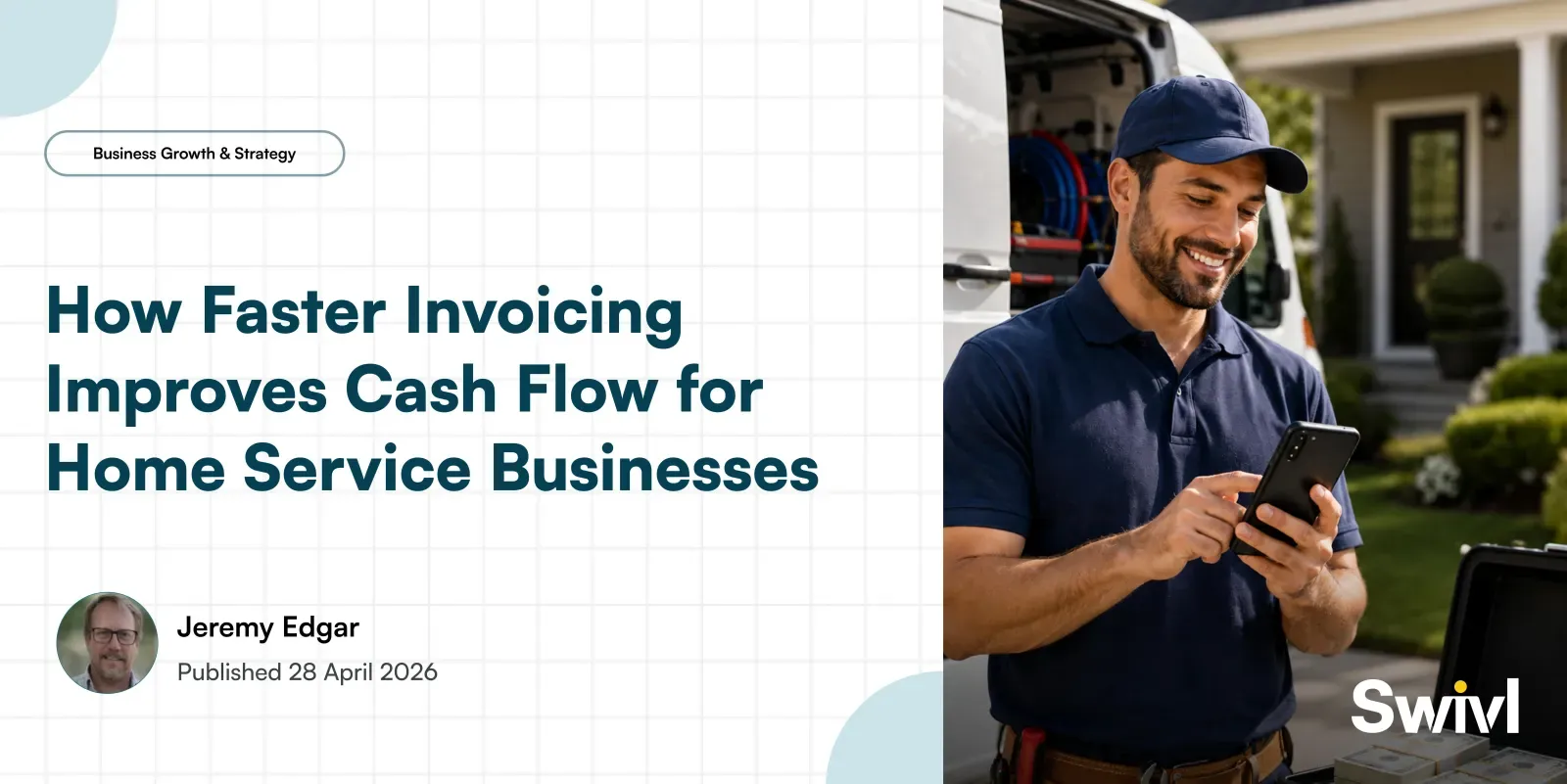
Table of Contents
Share this article
Why the Gap Between Job Completion and Payment Matters
Cash flow in a home service business is driven by one thing more than anything else: how quickly revenue from completed work makes it into your account. Every day between finishing a job and receiving payment is a day you are carrying that work at your own expense. You have already paid your technicians, your fuel, and your materials. The customer has the result. The money is the only thing still outstanding.
When invoices go out the same day the job is complete, payment timelines compress. When invoices sit in a queue and go out a week or two later, payment gets delayed by that same week or two — and collections become harder as the customer's memory of the service fades. Faster invoicing is not just an administrative improvement. It is a cash flow strategy.
What Slow Invoicing Actually Costs
Consider a business completing ten jobs per week at an average invoice value of $500. If the average gap between job completion and invoice delivery is five business days, the business is perpetually carrying about $5,000 in completed but unbilled work. That is $5,000 that could be available to cover payroll, materials, or equipment — but is not, because the billing process has not caught up.
This working capital drag is a leading source of operational strain across growing service companies. Financial management studies highlighted by the U.S. Small Business Administration (SBA) indicate that cash flow mismanagements and delayed receivables cause nearly 82% of small business failures. Letting unbilled work sit in administrative limbo directly threatens your company's solvency.
Add to that the psychological reality that payment delays increase as invoice age increases. A customer who receives an invoice within hours of job completion, while the interaction is still fresh, is more likely to pay quickly than one who receives it ten days later when they have mentally moved on. Late invoicing conditions customers to pay late.
The Case for Same-Day Invoicing
Same-day invoicing — sending the invoice the day the job is completed, ideally within hours — has a measurable impact on average days to payment. When the invoice arrives while the customer is still thinking about the work that was done, the connection between service and payment is clear and immediate. The invoice does not feel like an afterthought; it feels like the natural conclusion of the transaction.
Making same-day invoicing the default requires the right tools. If creating an invoice requires manual re-entry of job details from a tech's verbal report, it cannot happen consistently at the end of a busy day. But when invoices are generated automatically from job records — with line items, quantities, and prices pulled from the estimate — same-day invoicing is simply the default output of marking a job complete.
Swivl's invoicing tools connect directly to job records so that invoices can be generated and sent as soon as work is marked complete, without any manual re-entry.
The key to closing this gap is deploying a robust field service invoicing software that unifies field operations with back-office accounting in real time. Modern contractor billing software transforms how home service businesses handle cash flow by enabling on-site invoice generation the moment a job is finished. As technicians record real-time job status updates on their mobile devices, line items automatically populate with approved labor rates, materials, and equipment charges.
This eliminates manual administrative re-entry, allows your office to get paid faster field service invoicing solutions, and triggers automated payment reminders for any unpaid balances—ensuring your money lands in your account days or weeks faster.
Collecting Payment at Job Completion
The fastest possible invoicing workflow is not same-day invoicing — it is collecting payment before the technician leaves. When a tech can present the invoice on a mobile device, review it with the customer, and process payment on the spot, the entire receivables cycle is eliminated. The job is done, the customer is satisfied, the payment is in your account, and no follow-up is required.
This is increasingly the expectation in residential service. Customers are accustomed to paying immediately for services — Venmo, card tap, digital wallet. The friction of mailing a check or waiting for an invoice to arrive via email feels outdated. Businesses that offer on-site payment processing help fix field service cash flow by converting the job completion moment into payment collection, which is the most natural and frictionless point in the customer relationship.
Automated Reminders for Outstanding Invoices
Despite best efforts, some invoices will go unpaid after initial delivery. The difference between a business with healthy cash flow and one constantly chasing payments is usually not the quality of its customers — it is the consistency of its follow-up. Automated reminders at set intervals after invoice delivery — three days, seven days, fourteen days — keep outstanding invoices in front of customers without requiring your office staff to manually track and follow up on each one.
Consistency matters here more than messaging. A customer who receives a polite automated reminder on day three is far more likely to pay than one who gets a follow-up call on day eighteen after their invoice has been overlooked in the queue. Automation makes consistency the default.
Visibility into Your Cash Flow Position
Faster invoicing is most powerful when paired with visibility into your receivables position. How much is outstanding right now? Which invoices are overdue by more than 30 days? Which customers have consistently slow payment histories? This information should be available at a glance — not locked inside a billing tool that requires manual report generation.
Integrated reporting tools surface this data automatically so you can see your cash flow position in real time and make decisions about collections, purchasing, and staffing based on actual numbers rather than estimates.
Start Getting Paid Faster Without Changing How You Work
Faster invoicing does not require changing the quality of your work or how you interact with customers. It requires changing the systems behind the work — so that billing happens automatically, payment is easy to complete, and outstanding invoices are followed up on consistently.
By replacing manual paper trails with an all-in-one field service management software, you remove the friction between completing a job and receiving cash in the bank. See how Swivl's invoicing tools work and find out how much faster your cash flow could move.
Ready to transform your business?Transform your business
Join thousands of contractors already growing with Swivl's AI-powered platform.