
How Home Service Businesses Can Use AI Without Losing the Human Touch
Learn how home service businesses use AI receptionists, estimating tools, and field service software to improve customer communication while maintaining a human experience.
-2.webp)
Rob Heller
Published Apr 30, 2026
Last updated Jul 21, 2026
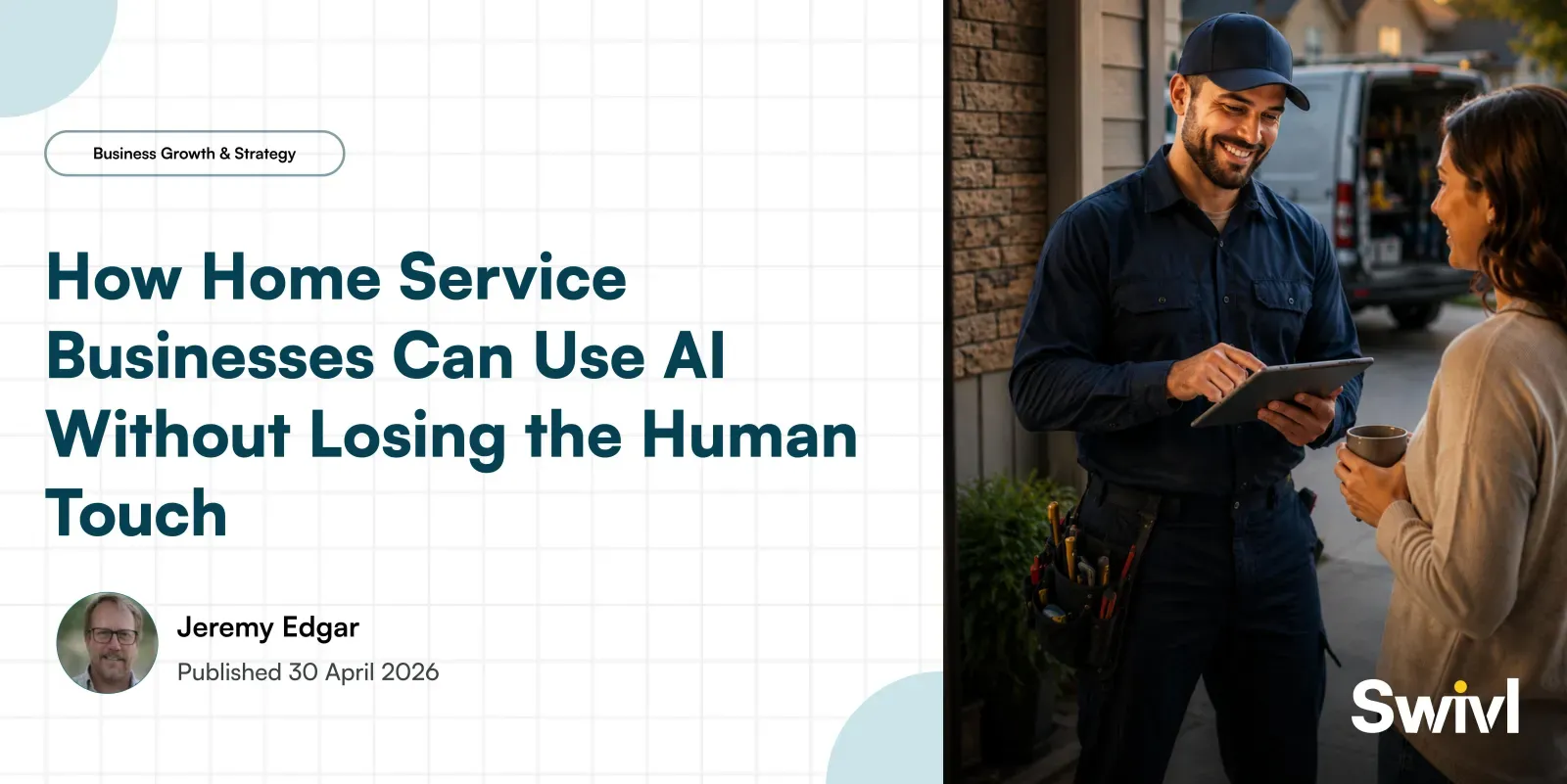
Table of Contents
Share this article
There is a version of AI adoption that every home service business owner fears: a future where robotic responses replace real relationships, where automation strips out the warmth that built the business in the first place. That fear is understandable but misplaced. The AI tools that actually benefit home service businesses are not designed to replace human connection — they are designed to protect it by eliminating the friction and repetition that currently consume the time needed to deliver it.
What AI Is Actually Good At in Field Service
AI tools perform best on tasks that are high-volume, time-sensitive, and rule-based. Answering the same five questions that every new customer asks. Sending appointment confirmations at the right time. Generating an invoice from a completed job record. Following up on an unpaid invoice at the three-day mark. Routing a technician to the next job based on location and availability. These are all tasks where speed and consistency matter far more than nuance — and where a human being is frankly wasted.
When AI handles this layer of work reliably, something valuable happens: the humans in your business get their time back. Your office manager is no longer spending three hours a day on appointment confirmations and invoice follow-up. Your technicians are not re-entering job details that should flow automatically from the work order. You are not personally chasing overdue payments. That recovered time is available for the interactions that actually require a human — complex customer situations, difficult service conversations, relationship-building with long-term clients.
The AI Receptionist: First Contact Without the Friction
The first place most home service businesses lose leads is on inbound calls they cannot answer. A potential customer calls during a busy period, reaches voicemail, and calls the next contractor on their list. The business never knew the call happened. An AI receptionist answers every call, collects the customer's name, service need, and contact information, and either books the appointment or routes the inquiry to the right person. The customer gets a prompt, helpful response. Your team gets a qualified lead with context. No one falls through the cracks.
The key to maintaining the human touch here is configuration. An AI receptionist that sounds natural, asks sensible questions, and handles edge cases gracefully feels professional rather than robotic. One that is poorly configured creates friction and erodes the first impression your business makes. The tool is only as good as the setup behind it.
AI Estimating: Speed That Serves the Customer
One of the clearest ways AI serves both efficiency and customer experience is in estimating. When a customer is comparing quotes from three contractors, the first one to deliver a professional, detailed proposal has a real advantage. An AI estimator that generates proposals from your price book and job history can get a quote to a customer in minutes rather than hours. That speed is not impersonal — from the customer's perspective, it signals responsiveness and competence.
The estimate itself is also an opportunity for human connection. A technician who presents a detailed, well-formatted proposal on a tablet while walking a customer through what the job involves is having a sales conversation supported by AI output — not replaced by it. The quality of that conversation determines whether the customer books. The AI just ensures the proposal is ready when it needs to be.
Automated Communication That Still Feels Personal
Automated appointment confirmations, arrival notifications, and payment reminders can feel impersonal if they are generic — but they do not have to be. When automated messages include the customer's name, the technician's name, the specific service being performed, and a direct reply option, they feel like communication rather than system noise. Customers appreciate being kept informed, even when the message was generated automatically.
The human touch in automated communication comes from the design: using a warm, natural tone, including specific details that show the system knows who the customer is and what they booked, and making it easy for the customer to reach a real person if they have a question. Automation handles the volume; the design makes it feel personal.
Where Humans Should Stay in the Loop
AI is not a substitute for human judgment in situations that require it. A customer who is upset about a service outcome needs a real conversation with someone who can listen, empathize, and resolve the problem. A technician assessing an unusual or complex situation needs to apply experience and judgment that no AI tool can replicate. A long-term client relationship is built through repeated positive human interactions over time — AI can support the logistics of those interactions but cannot replace the relationship itself.
The most effective approach is to define clearly which parts of your customer journey benefit from automation and which require human attention. Routine, time-sensitive, repeatable interactions — automation. Complex, emotionally loaded, relationship-defining interactions — humans, with AI freeing up their time to be fully present.
Adopt AI in a Way That Reflects Your Business
The businesses that get the most from AI adoption are not the ones that automate everything — they are the ones that automate thoughtfully, preserving what makes their customer experience distinctive. Start with the high-volume, low-nuance tasks: call answering, appointment confirmations, invoice generation, payment reminders. Measure the time recovered. Then decide where that time is best reinvested. See how Swivl's AI tools work in practice and find out what your business could look like when the repetitive work takes care of itself.
Ready to transform your business?Transform your business
Join thousands of contractors already growing with Swivl's AI-powered platform.