
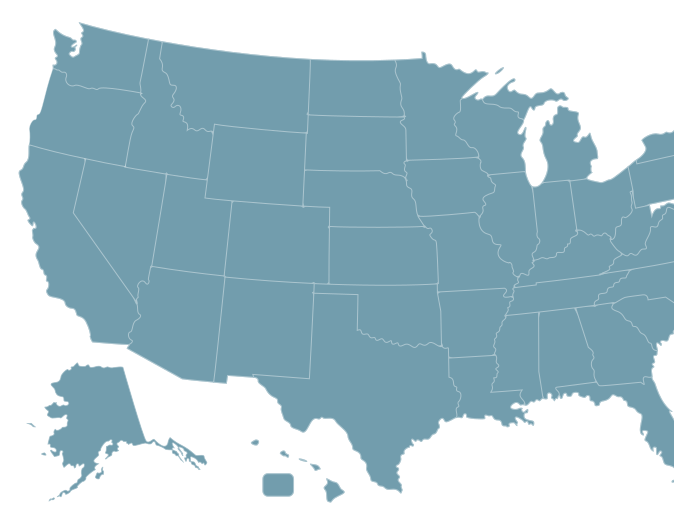


Wichita Falls electrician wage context
The May 2025 BLS Occupational Employment and Wage Statistics estimate for the Wichita Falls metropolitan area reports an estimated 190 wage-and-salary electricians. Its hourly employee-wage benchmarks are:
| Measure | Hourly employee wage |
|---|---|
| Median (P50) | $21.91 |
| Mean | $24.91 |
These are employee wages, not an hourly billable rate. OEWS excludes self-employed workers, and it does not include your payroll taxes, benefits, vehicle, tools, dispatch, office overhead, warranty exposure, materials, or profit.
Texas-wide ACS PUMS employee-earnings context for electricians in 2024 is:
| Measure | Imputed hourly employee earnings |
|---|---|
| P25 | $16.92 |
| Median (P50) | $23.43 |
| P75 | $33.19 |
ACS provides a second, Texas-wide earnings signal. The estimate includes Texas wage-and-salary electricians and uses ACS person weights to calculate weighted percentiles. It is not Wichita Falls-specific.
How the ACS estimate was calculated
This custom estimate uses PUMS occupation code SOCP=472111, corresponding to electricians and mapped here to SOC 47-2111. It includes Texas wage-and-salary workers only (class-of-worker codes 1-5), with positive wage income, usual weekly hours, weeks worked, adjustment factor, and person weight. Zero or missing values are excluded; top-coded values are retained as published. Annual wage income is adjusted with ADJINC, divided by reported usual weekly hours × weeks worked, and weighted using PWGTP.
For this electrician estimate, 776 unweighted records represent an estimated 97,548 Texas wage-and-salary workers. Weighted percentiles use the first record at or above the cumulative-weight threshold. See the 2024 PUMS occupation code list and the Texas person file.
How to calculate a loaded electrician labor rate
BLS ECEC Table 4 reports that private-industry construction/extraction occupations had an average $31.69 in wages and $14.51 in benefits per hour in March 2026. That is an employer-cost multiplier of 1.4579. It is a national, broad-occupation benchmark, not a Wichita Falls electrician burden rate.
Using Wichita Falls's OEWS median only as an example:
$21.91 employee wage × 1.4579 broad employer-cost multiplier = $31.94
Treat $31.94 per employee hour worked as an illustrative loaded-payroll starting point. It does not account for your ratio of paid hours to productive field hours, and it is not a target quote or market price.
To convert that starting point into productive field-hour cost, enter your own productive-hour ratio:
$31.94 loaded payroll cost per paid hour ÷ productive-hour ratio
At 75% productive utilization, the illustration becomes $42.59 per productive field hour. That is an example, not a Wichita Falls benchmark.
Calculate electrician labor cost for a job
Use your real inputs. If you do not know one yet, leave it visible as an assumption instead of hiding it in a flat-rate price.
Loaded payroll cost per paid hour = actual wage × payroll burden factor
Productive labor cost per field hour = loaded payroll cost ÷ productive-hour ratio
Job labor cost = productive labor cost per field hour × estimated field hours
Total job cost = technician labor + helper labor + materials + permits
                 + equipment + travel/dispatch + subcontractors + job overhead
Required revenue at target gross margin = total job cost ÷ (1 − gross-margin rate)
For example, enter your actual technician wage, the hours you expect the job to take, the material estimate, and the margin you need. The calculation shows required revenue at your target gross margin, derived from your inputs, not a citywide customer-price claim. A 40% gross-margin target means dividing total job cost by 0.60; it does not mean adding 40% to cost. Your final quote can still reflect scope risk, warranty exposure, minimum service charges, and market positioning.
Additional Wichita Falls and Texas market context
Wichita County electrical-contractor industry
| Wichita County electrical-contractor context, 2025 | Value |
|---|---|
| Private establishments | 42 |
| Average employment | 311 |
| Average weekly wage, all industry employees | $1,163 |
This QCEW Wichita County NAICS 23821 source file covers all occupations in the industry, so it is not an electrician wage and should not go into a labor-cost formula. An establishment is a physical business location, not necessarily a unique company; one company operating multiple locations may be counted more than once. It is evidence of an active local electrical-contractor market, not a pricing signal.
Texas regional price context
Texas's 2024 BEA all-items Regional Price Parity data was 97.1, where the U.S. average equals 100. This is broad state-level consumer price context shared by Austin, Dallas, and Houston. It does not distinguish Wichita Falls from other Texas metros and should not be used as a labor, burden, or pricing multiplier.
Use this guide before you quote
- Start with your actual payroll wage, not the public median.
- Compare it with the Wichita Falls OEWS context to spot a major mismatch.
- Add the burden, dispatch, materials, overhead, and margin your business actually carries.
- Save the assumptions with the estimate so you can compare forecast versus actual job cost later.
Use the calculator above with your own inputs, then use the public benchmarks as context, not as a substitute for your business economics.
Frequently asked questions
What is the median electrician wage in Wichita Falls?
The May 2025 BLS OEWS median wage for wage-and-salary electricians in the Wichita Falls metropolitan area is $21.91 per hour. It is an employee wage, not a customer billing rate. See the official OEWS table for the published Wichita Falls data.
How do you calculate loaded labor cost for an electrician?
Multiply the electrician's actual hourly wage by your payroll burden factor. The broad public-data illustration on this page is $21.91 × 1.4579 = $31.94 per paid employee hour. Replace both inputs with your own payroll data.
How do productive hours affect electrician labor cost?
Paid hours include time that may not be assigned to billable field work. Divide loaded payroll cost per paid hour by your productive-hour ratio. At 75% utilization, the illustrative $31.94 paid-hour cost becomes $42.59 per productive field hour.
What is a fully burdened electrician labor rate?
A fully burdened electrician labor rate combines the employee wage with the employer payroll costs assigned to that hour. To estimate the cost of a productive field hour, divide that loaded paid-hour cost by your productive-hour ratio. It is an internal cost input, not a customer billing-rate recommendation.
Is electrician labor cost the same as an hourly billing rate?
No. Labor cost is one input. A billing rate or flat-rate quote may also need to recover vehicles, tools, dispatch, permits, materials, subcontractors, job overhead, warranty risk, scope risk, and the business's target gross margin.
Sources and methodology
- BLS OEWS, May 2025 Wichita Falls electricians, SOC 47-2111. Published series:
OEUM004866000000047211108(median) andOEUM004866000000047211103(mean). Extraction records:bls-oews-2025-48660-472111-p50andbls-oews-2025-48660-472111-mean. - ACS 2024 1-year PUMS Texas person file Texas wage-and-salary employee earnings distribution for PUMS occupation category
SOCP=472111, reported alongside SOC 47-2111. Record:acs-pums-2024-TX-472111. - BLS ECEC, March 2026 Private-industry construction/extraction/farming/fishing/forestry occupations. Record:
bls-ecec-2026q1-construction-extraction. - BLS QCEW, 2025 annual average Wichita County, NAICS 23821. Record:
bls-qcew-2025-48485-23821. - BEA Regional Price Parities, 2024 Texas all-items index. Record:
bea-rpp-2024-TX.
The source links above lead to the official table or downloadable file used for each benchmark. Extraction identifiers, reference periods, measurement boundaries, and geographic limitations are included so readers can judge relevance before relying on any value.