
Why Generic AI Estimating Tools Fail Field Service Contractors (And What Actually Works)
A definitive guide for field service contractors on avoiding the margin-eroding traps of generic, one-size-fits-all AI estimating tools in 2026. This article breaks down why generic calculators fail, from using irrelevant national averages and ignoring real local labor rates to lacking historical job context. Discover how a trained, trade-specific AI estimator like Swivl connects directly to your flat-rate price book for smart price book management, leveraging your actual material and labor cost tracking and past job data. By using a modern contractor quote builder with one-click estimate conversion, trade professionals in HVAC, plumbing, electrical, and general contracting can deliver fast, legally binding quotes that protect profit margins and streamline the entire quote-to-close workflow.

Jonathan Tyson
Published Mar 12, 2026
Last updated Aug 29, 2026
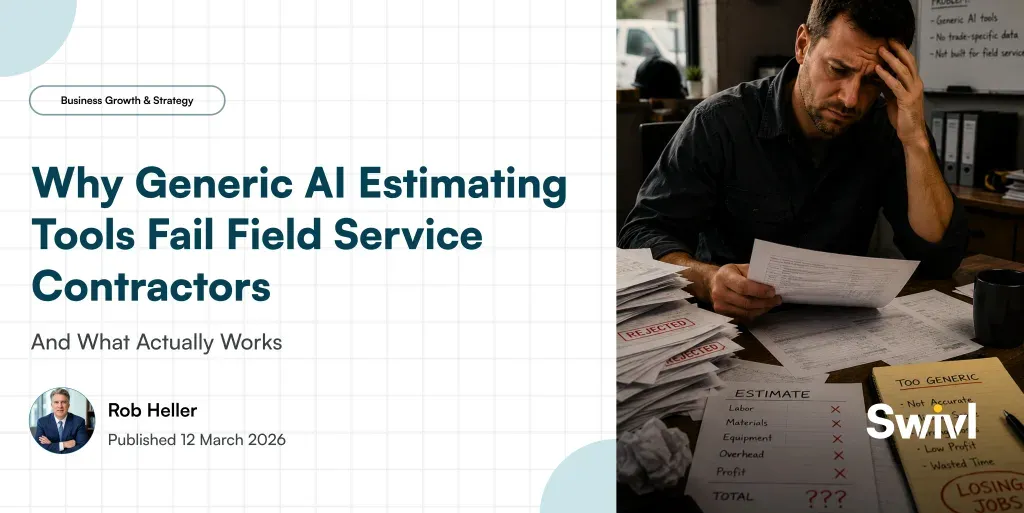
Table of Contents
Share this article
Every field service contractor eventually hits the same wall. You spend an hour putting together what feels like a solid estimate, send it off, and either never hear back or win the job only to discover you left money on the table. When AI estimating tools started promising to fix this problem, plenty of contractors tried them, and most walked away frustrated.
The issue is not AI itself. The issue is that most AI estimating tools were built as general-purpose calculators with no understanding of what it actually costs to run an HVAC truck, staff a cleaning crew, or dispatch a plumber across three different job types in the same afternoon. They pull from generic databases, industry averages, and national benchmarks that have nothing to do with your market, your overhead, or your labor rates.
For a field service contractor bidding real jobs in a specific market with real costs, generic AI estimating is often worse than no AI at all. It gives you false confidence in numbers that do not reflect your business.
What Generic AI Estimating Tools Actually Do Wrong
1. They Use Averages That Do Not Apply to Your Market
A national average for drain cleaning or duct sealing means very little if you are operating in a market where labor costs are significantly higher than the national median, your insurance rates reflect a high-liability trade, and your material suppliers charge regional premiums. Your real labor cost is not a wage you can look up, either: per IRS Topic 751, the employer side alone adds 6.2% for Social Security and 1.45% for Medicare on top of every hour you pay, before workers' compensation and unemployment insurance. A tool that starts from a national wage is already wrong before it reaches your market. Generic AI tools do not know any of this. They see the job type and produce a number based on aggregated data from thousands of businesses that are nothing like yours.
The result is estimates that are either too high (losing you bids to competitors who know their actual cost structure) or too low, meaning you win jobs that erode your margin every single time.
2. They Cannot Learn From Your Job History
One of the most valuable things a seasoned contractor carries is pattern recognition. You know that a certain type of bathroom remodel always runs longer than it looks on paper. You know which job categories your crew handles efficiently and which ones eat into time. You know which customers tend to ask for extra work once you are on site.
Generic AI tools have no access to that history. Every estimate starts from zero. There is no compounding intelligence, no refinement based on what actually happened on your last 50 jobs. You are essentially using a sophisticated calculator that ignores the most useful data you have.
3. They Create a False Sense of Accuracy
When an AI tool produces a number, even a wrong one, it looks authoritative. The interface is clean, the output is formatted, and the estimate reads like it was calculated carefully. That polish can cause contractors to trust the number more than their own judgment, which is a dangerous trade-off when your actual costs tell a very different story.
Run the check on your own books. Pull your last twenty completed jobs, put the quoted number next to the final labor hours and material invoices, and count how many came in over. The tool looked right on every one of them. That is the failure mode: not an obviously wrong number, but a confident one.
What a Trained, Trade-Specific AI Estimator Does Differently
The difference between a generic AI estimating tool and a trained, trade-specific one is the difference between a random person doing your bookkeeping and an accountant who has worked with your business for three years. One has general knowledge. The other has context.
1. It Builds From Your Price Book, Not a Database
Setting up your pricing foundation begins with smart price book management. Unlike generic tools that rely on outdated national averages, a trade-specific system leverages your custom flat-rate price book to reflect your local market rates, equipment costs, and overhead. By integrating a dynamic contractor quote builder, the AI automatically generates estimates that draw from your preloaded materials, labor packages, and custom margins. This ensures every quote sent out is instantly competitive, fully customized, and guaranteed to protect your bottom line before your crew even arrives on-site.
2. It Gets Smarter With Every Job You Complete
When your estimating tool connects to your job history, meaning the actual hours logged, materials used, and final costs from completed jobs, it builds intelligence over time. It notices that your crew consistently takes longer on certain job types, that certain materials run over budget, or that particular job categories consistently hit your target margin. That pattern recognition shapes future estimates in a way no generic tool ever could.
This is why the AI estimator for field service businesses built into Swivl improves with use. The more jobs that flow through the platform, the more the estimating layer reflects your real cost structure and your real margins.
3. It Produces Estimates That Are Legally Binding From the Start
One of the hidden costs of generic AI estimating is that the output still needs to be formatted, sent, followed up on, and converted into a signed agreement before work begins. A tool built for field service handles that entire workflow: estimate creation, digital delivery, customer signature, and automatic conversion to a work order once approved. You are not just generating a number. You are running a complete quote-to-close process.
The Real Cost of Estimating Errors in Field Service
Estimating errors are rarely dramatic. They do not show up as a single catastrophic loss. They erode your business quietly, job by job. A bid that comes in five percent under your real cost is not a disaster on its own. But across 200 jobs a year, that consistent underpricing is the difference between a profitable business and one that is always working hard but never getting ahead.
The arithmetic is worth doing on your own numbers rather than borrowing anyone else's. Take your average ticket, multiply by the jobs you close in a year, and apply the underpricing you just measured. A shop underquoting by 6% on 200 jobs a year at a $1,400 average ticket gives away $16,800 of margin without a single dramatic loss ever appearing on the books.
A trained estimating system does not make you win more bids. It makes the bids you do win ones you can actually profit from, because the number leaving your office is built from your costs rather than from someone's average. The field service invoicing and estimating workflow around that number matters as much as the accuracy of the number inside it.
Who This Matters Most For
1. HVAC and Plumbing Contractors
In HVAC and plumbing, equipment costs and labor variability make generic estimating particularly risky. A system installation that looks like a two-hour job on paper can become a six-hour job depending on access, existing infrastructure, and site conditions. A trained estimator that knows your job history can flag when a job type historically runs longer and build that buffer into the quote automatically.
2. Electrical and General Contractors
For electrical contractors and general contractors managing multiple subcontractors and variable material costs, the margin for estimating error is thin. A tool that accounts for your subcontractor rates, your markup policies, and your permit and inspection costs produces estimates that are defensible from the first number the client sees.
3. Solo Operators and Small Teams Scaling Up
When you are a solo operator or running a small crew, every estimate matters because there is no volume to absorb the cost of consistent mispricing. Getting a trained AI estimator in place early, before scale, means you are building your pricing discipline into the foundation of the business rather than trying to fix it after you have locked in bad habits across hundreds of jobs.
How to Evaluate an AI Estimating Tool for Your Field Service Business
When assessing any estimating tool, ask these questions before committing:
- Does the tool connect to my price book, or does it generate estimates from generic databases? If it cannot read your own pricing, it cannot estimate accurately for your business.
- Does the tool learn from completed jobs? A tool that improves over time is fundamentally more valuable than one that starts fresh on every estimate.
- Does the estimate flow into a complete job management workflow? The estimate is not the end of the process. It needs to convert to a quote, get signed, become a work order, and eventually produce an invoice. Tools that handle only the estimate step still leave you managing the rest manually.
- Is it built for your trade or for everyone? General contractors, cleaning companies, HVAC businesses, and roofing contractors all have meaningfully different cost structures. A tool built for field service trades is going to serve you better than one built as a generic business tool that happens to include an estimating feature.
Beyond generating speedier quotes, a truly effective AI tool must deliver accurate material and labor cost tracking across the entire project lifecycle. Modern platforms equipped with contractor workflow automation ensure that approved estimates transition seamlessly into digital work orders, time tracking, and final invoices. By deploying an all-in-one platform with one-click estimate conversion, contractors eliminate administrative disconnects, reduce manual errors, and maintain complete profit margin visibility from initial customer contact to final job completion.
Accurate Estimates Are a Competitive Advantage
Most field service contractors are competing on speed, reputation, and price. Two out of three of those are hard to control. Pricing is the one variable you have direct authority over, and accurate estimating is how you use that authority wisely.
When your estimates are consistently accurate, you win jobs you can actually profit from. You quote confidently, you negotiate from a position of knowledge, and you stop second-guessing numbers in the field. That is the real value of a trained AI estimator: not the novelty of AI, but the reliability of estimates that reflect your actual business.
If you are done guessing on bids and ready for estimates that are built on your data, your rates, and your job history, see how the Swivl AI Estimator works and find out what consistent, margin-protecting pricing looks like for your trade.
You can test this on your own jobs before paying for anything. Start free with Swivl, load your price book, and estimate the next ten jobs both ways: what the tool says up front, and what the job actually cost when it closed.
Ready to transform your business?Transform your business
Join thousands of contractors already growing with Swivl's AI-powered platform.