
What does it take to build an electrician company? Lessons from Michael Lail
Michael Lail bought the electrical company he worked for in 2019 and grew it from about $1.2 million a year to a projected $8 million. How he bought it, why he pays for his electricians' schooling, how he makes net 90 pay, and what software should cost.

Rob Heller
Published Nov 9, 2026
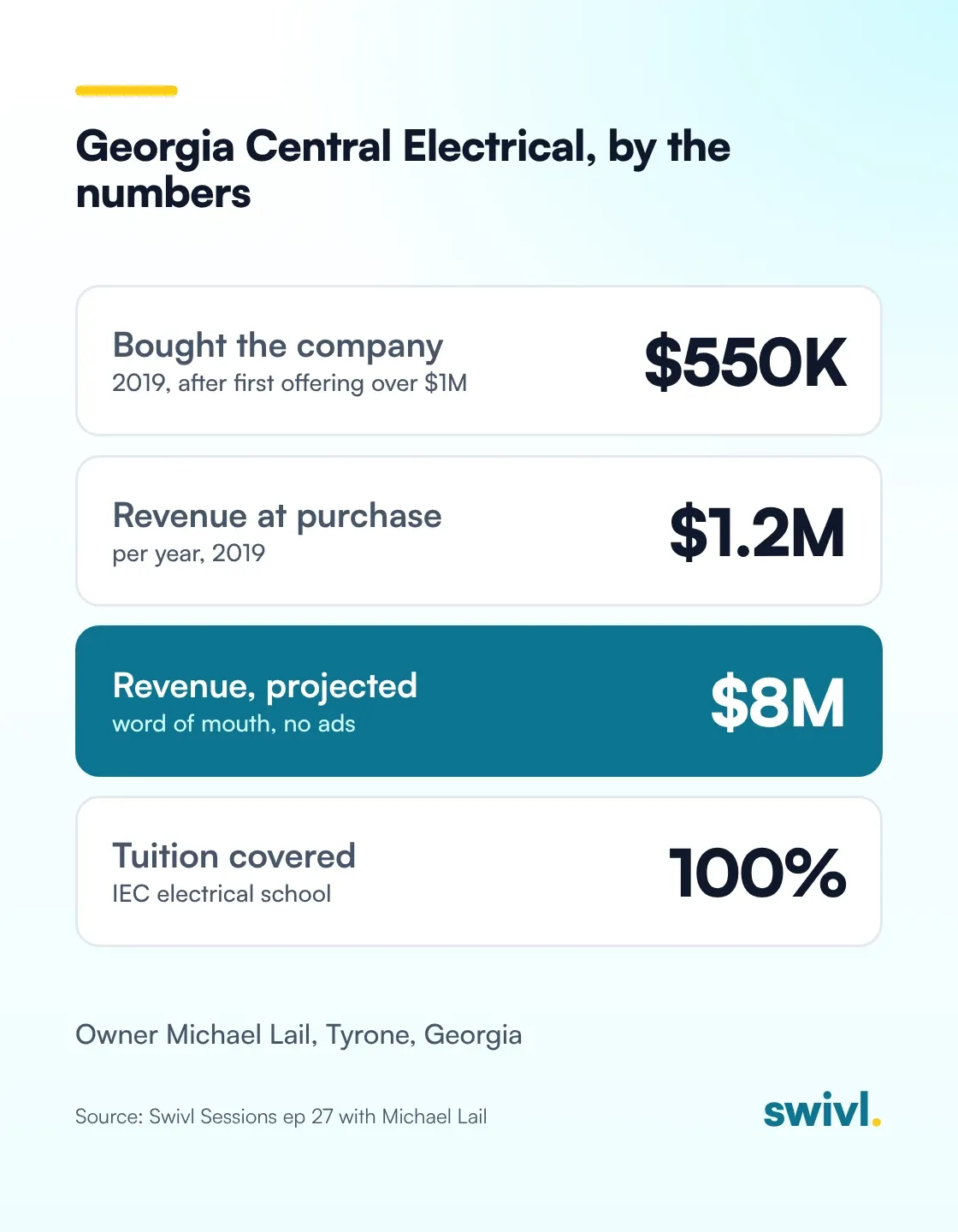
Table of Contents
Share this article
Follow us on Facebook
We post our customers’ work — the jobs, the before and afters, the trucks. Come and have a look.
Learn the business side as seriously as the trade, and invest in your people. Michael Lail bought the electrical company he worked for in 2019, when it did about $1.2 million a year, and grew it to a projected $8 million by paying for his electricians' schooling and earning commercial work by word of mouth.

Michael Lail owns Georgia Central Electrical in Tyrone, Georgia. It does commercial and industrial electrical work around the Atlanta metro, no residential, for customers like Home Depot, Hobby Lobby, oil refineries and food processing plants. He bought the company in 2019, when it brought in about $1.2 million a year, and grew it to a projected $8 million. He told the whole story on Swivl Sessions episode 27.
I ran a plumbing company for years before I built Swivl, and a lot of what Michael said sounded familiar. These are the parts I'd pull out for any electrician thinking about running their own shop.
How did Michael Lail go from a high school class to owning the company?
It started with a filler class in high school: a switch, a breaker and a light. That was enough to hook him, and he's been in the electrical trade ever since.
He spent years working for a local electrical company. When the owner decided he wanted to keep it small, Michael wanted to grow it, so he bought it. That meant he started with customers and a crew already in place.

Should you buy an electrical business or start one?
Michael's case for buying is that an existing company already has systems and customer relationships. You skip the years of scraping for the first accounts.
How he bought it is worth hearing. He first offered over $1 million. He ended up paying about $550,000. His advice from the episode comes down to a few habits:
- Be willing to walk away, and let timing work for you in a negotiation.
- Normalize the financial statements so you see what the business really earns, beyond the profit line on the surface.
- Ask the seller to finance it when you can. Owner financing often beats a bank loan on terms.
He has since paid off the acquisition financing, and the company is debt free. Buying doesn't fit everyone. You need a seller, and you need to be able to carry the payments. If a shop you know is owned by someone ready to step back, though, it's worth a conversation before you buy your own van.
Why does a good electrician need to learn the business side?
This was the line from the episode that stuck with me most:
“Just because you're a good electrician doesn't make you a good business owner.”
He was referencing The E-Myth. Michael has read hundreds of business books, and he keeps mentors he can call. His advice to anyone starting out is to read a lot, because being good at the work is not enough.
At the plumbing company, I struggled to make payroll many times and got stuck in contracts paying for things I didn't use. Neither one was a plumbing problem. The trade gets you in the door, and the business side decides whether you're still around in five years.
How do you hire and keep good electricians?
Michael pays 100% of tuition for his people to attend IEC electrical school, as long as they keep their grades up, and he teaches classes himself. He wants a clear path for each person to grow inside the company. His reason for all of it is simple:
“I build a company that people have a job they enjoy coming to. That's the reason I built the company.”
The best hire I ever made was Chris Counts, and he ended up being my partner. I gave him some equity to make sure he stayed. What I liked most was his foundation: character, integrity, honesty. For some reason that's hard to find in the plumbing industry. He'd been through some rough patches in life and came out of them having decided on a course built on honor, integrity and trust.
He also had humility. He came on eager to do anything that would help, which at the time was sales. He passed out marketing material, talked to customers and built relationships that grew the business. Later he moved back to Florida for family. I said, why don't we start a new branch down there? He did, and it worked. Today Chris runs his own Skyline companies, Skyline Services and Skyline Contracting, and he's one of Swivl's best customers.
The lesson I learned is to stick to the basics. Would you trust this person with your children? Then you can trust them with your business. Michael's tuition program works the same way from the other side: hire people with the right foundation, then pay to make them better.
A 23-second customer review short from Swivl's YouTube channel featuring Chris Counts, titled "I Can Run My Business Flawlessly", about running his business in Swivl.
How can net 90 terms work in your favor?
Most small shops treat net 90 as something to avoid. Michael builds it into his price. About 10% of his clients bring in about 90% of his revenue, and the big commercial accounts pay on net 15 to net 90. When a customer wants net 90, he charges for the wait.
“The net 90 keeps other people out. I can't compete financially with two guys running a beat up pickup truck, but they can't afford to do net 90.”
That only works with cash in the bank and a real handle on accounts receivable. Michael's advice is to invest in AR management if you're going to carry net 30 to 90 accounts. I've struggled to meet plumbing payroll many times, so I'd take that part seriously. If you can't carry the wait yet, price it in or don't take it.
He doesn't advertise, either. Word of mouth brings him more work than he can keep up with, and in his view a company that advertises is telling customers it needs the work. For more on getting paid on time, read our guide to contractor invoicing software.
Swivl Sessions episode 27 with Michael Lail, owner of Georgia Central Electrical in Tyrone, Georgia. He covers buying the company in 2019, negotiating the price down, commercial clients like Home Depot, paying 100% of his electricians' tuition, the 90/10 client mix, and turning net 90 terms into profit. Jump to net payment terms at 21:00 or software at 24:00.
What should software cost a growing electrical contractor?
Michael's advice on technology is blunt. Don't try to manage growth on Excel spreadsheets, plan for how your systems will work together, and expect to invest thousands, not hundreds. That's sound advice for a shop his size. A company doing $8 million in commercial work on net 90 terms needs real accounting and AR tools next to its field software.
Most electricians reading this aren't there yet. If you have one to five trucks, the software bill shouldn't grow every time you hire. Swivl has no per-seat or per-technician charge on any plan. The Starter plan is $0 a month, free forever, with unlimited users, customers, estimates and invoices, plus scheduling and dispatch, the mobile app and time tracking. You pay for credits only when you use the metered features, like the AI Estimator at about 60 credits an estimate.

Two features need a paid plan. The AI Receptionist starts at Growth ($49 a month), and GPS tracking starts at Scale Pro ($149 a month). Card payments carry the payment processor's fee, and there's no contract, so you can drop back to Starter any month. If you're bigger than this, or growing toward it, read our honest guide to electrician business software for how the options compare.
Frequently asked questions
Is it better to buy an electrical company or start one?
Buying gets you customers, a crew and systems on day one, but you need a willing seller and the cash flow to carry the payments. Michael Lail bought the company he worked for in 2019 for about $550,000, using negotiation and financing to make it work.
How much can an electrical contracting company make?
It depends on your market and your work mix. Georgia Central Electrical, a commercial and industrial shop, went from about $1.2 million a year in 2019 to a projected $8 million, per Michael Lail on Swivl Sessions.
How do electrical contractors handle net 90 terms?
Michael Lail prices the wait in, charging what he calls an interest rate for net 90 accounts. That takes cash reserves and solid accounts receivable management, so a smaller shop should price it in or turn it down.
Should I pay for my electricians' schooling?
Michael Lail pays 100% of IEC electrical school tuition for employees who keep their grades up, and teaches classes himself. It gives people a reason to stay and a path to grow inside the company.
Does electrician software charge per technician?
Swivl doesn't. It has no per-seat or per-technician charge on any plan, including the $0 Starter plan with unlimited users, estimates and invoices.
Free to start. No contract. No sales call.
Start freeReady to transform your business?Transform your business
Join thousands of contractors already growing with Swivl's AI-powered platform.