
How to Fix On-Site Payment Collection in Your Field Service Business
Stop chasing "bad debt." Learn why traditional invoicing is hurting your cash flow and how on-site "Tap to Pay" technology ensures you get paid the moment the job is done.
-2.webp)
Rob Heller
Published Mar 10, 2026
Last updated Aug 31, 2026
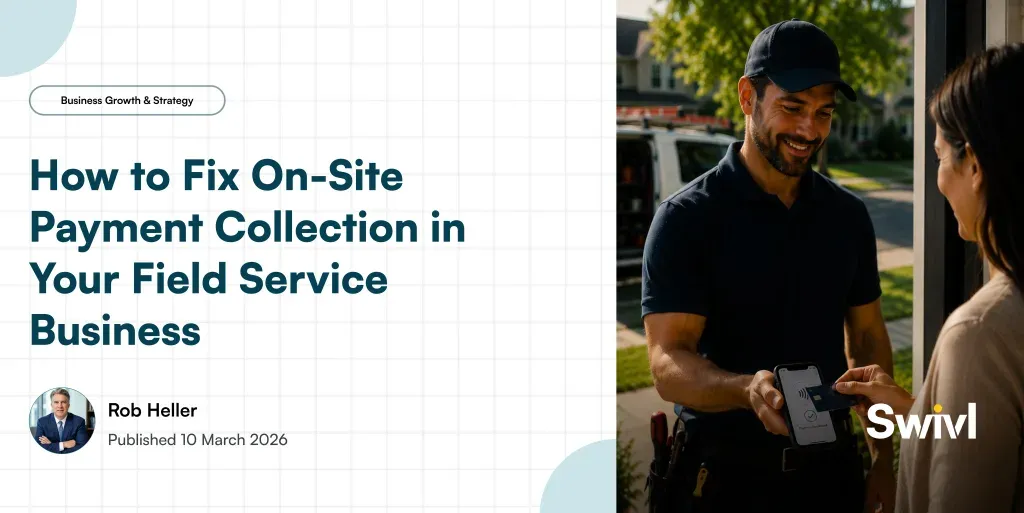
Table of Contents
Share this article
How to Fix On-Site Payment Collection in Your Field Service Business
You did the work. You showed up on time, completed the job professionally, and left the customer satisfied. But three weeks later, the invoice still has not been paid. You have sent two follow-up emails, left a voicemail, and now you are spending your Saturday morning chasing down money you already earned.
For field service businesses, delayed payments and outright non-payments are not just frustrating. They are a direct threat to cash flow, operations, and growth, and the traditional invoicing model that most home service businesses rely on makes the problem almost inevitable.
"People just feel like they don't have to pay, and we are getting left with a crazy amount to consider 'bad debt.'"
Man Ant Services, Swivl Sessions
Why Payment Collection Is a Structural Problem, Not a Customer Problem
Most field service owners blame slow-paying customers. And while some customers genuinely take advantage of lax billing practices, the real issue is structural. The traditional payment workflow (complete the job, send an invoice later, wait for payment, follow up repeatedly) introduces friction at every step. The longer the gap between job completion and payment request, the more likely the customer is to dispute the charge, forget the details, or simply deprioritize it.
For small to medium-sized home service businesses, the impact compounds fast. Delayed payments mean delayed payroll, delayed materials purchasing, and delayed reinvestment in growth. When multiple jobs are in arrears simultaneously, cash flow can tighten to the point where a business that is technically profitable on paper cannot cover its week-to-week expenses.
Nobody publishes a trustworthy average for how long a trade waits to get paid, and the figures that circulate come from billing vendors with no method attached. You do not need the industry number anyway. Pull your last 90 invoices, subtract the job completion date from the payment date, and take the median. That is your real collection lag, and every day of it is a day your money is working for the customer instead of for the business that earned it.
Why Most Businesses Struggle to Fix the Problem
Many field service operators know the system is broken but feel stuck. Asking for payment upfront feels awkward, especially for new customers. Chasing invoices feels unprofessional. Adding late fees creates friction. And requiring deposits can cost you jobs before they start.
The root issue is that manual billing processes create gaps: between the job and the invoice, between the invoice and the reminder, between the reminder and the collection. Each gap is an opportunity for the payment to fall through. Without a system that captures payment at the natural close of a transaction, you are perpetually fighting an uphill battle.
"That's why I get money up front and I kind of make, only really work with builders that pay me as soon as I'm finished."
Hatcher Plumbing, Swivl Sessions
What the most experienced operators have figured out is that the best time to collect payment is immediately when the work is done, while the customer is satisfied and standing right in front of you.
How On-Site Payment Collection Changes Everything
Swivl's Tap to Pay feature lets field service technicians collect payment on-site, from a phone, the moment the job is complete. No paper receipts and no waiting. The customer taps their card or device, the payment goes through on the spot, and both parties walk away with confirmation.
This single change eliminates the most common payment failure points. There is no invoice to dispute three weeks later because the transaction happened while the work was fresh. There is no awkward follow-up conversation because the payment expectation was set before the job started. And there is no “bad debt” category growing quietly in your books because you never left the site without getting paid.
Paired with Swivl's automated invoicing and estimates, technicians can generate a professional invoice directly from the job record, send it to the customer for review, and collect payment, all from the same app and all before leaving the driveway.
What a Centralized Finance Hub Does for Your Cash Flow Visibility
Collecting payment on-site is only part of the fix. The other half is knowing, at any moment, exactly where your money stands. Swivl's payment tools track every payout in real time and show balances and payouts in one place, so you are not reconciling across separate apps or waiting until month-end to understand your cash position.
Seeing balances and payouts as they move, rather than reconstructing them from a bank statement at month end, changes how you manage payroll, materials, and growth decisions. Ask any provider, ours included, how long a payout actually takes to reach your account, and get that answer in writing before you switch. When you know what is coming in and when, you can plan with confidence instead of guessing.
This also connects directly to the broader picture of business health. When your reporting and analytics show revenue alongside job costs and crew performance, you can see which service lines are actually profitable rather than merely busy.
What Changes When You Solve the Payment Problem
Fixing on-site payment collection is not just a financial upgrade. It changes how the entire business operates. When you stop chasing payments, you free up significant time and mental energy that was previously consumed by billing admin, follow-up calls, and dispute management. That time goes back into the work that actually grows the business.
Here is what the shift looks like in practice for most home service businesses:
- Cash flow improves immediately. Payment collected on-site means there is no invoice sitting in someone's inbox for weeks. Revenue lands close to the work.
- Administrative time drops sharply. Automated invoicing and payment processing eliminates the manual follow-up cycle that consumes hours every week.
- Customer experience improves. Quick, seamless on-site payment leaves a professional impression and removes the friction of receiving an invoice days later.
- Bad debt disappears. When payment is collected before leaving the job site, there is nothing to chase and nothing to write off.
- Growth becomes fundable. Predictable cash flow means you can make hiring, equipment, and marketing decisions based on real data, not guesswork.
How On-Site Payments Fit Into Your Broader Field Service Operations
Payment collection does not exist in isolation. It is one part of a larger operational chain that runs from the moment a lead comes in, through scheduling and dispatch, through job execution, and finally through billing and follow-up. When any link in that chain breaks down, the whole system leaks.
Swivl connects the full chain. Your scheduling and dispatch puts the right technician on the right job at the right time. Your field service CRM keeps every customer interaction documented and accessible. And on-site Tap to Pay closes the loop at the job site so revenue is captured the moment the work is complete.
For businesses struggling with both missed calls and missed payments, adding an AI receptionist ensures leads are captured and responded to immediately, so you are not only getting paid on the jobs you complete but actually booking more of them in the first place.
Three Things Every Field Service Business Should Do Right Now
If payment collection is a friction point in your business, here is where to start:
- Shift to on-site payment collection. Make payment part of the job close, not a separate administrative task. Set the expectation with customers upfront so there is no surprise at the end.
- Automate your invoicing. Stop creating invoices manually after the fact. Use a system that generates accurate invoices from the job record and sends them immediately upon completion.
- Get visibility into your cash position. Use a system that shows outstanding balances, processed payments, and payout tracking in one place, so you are never flying blind on your own cash flow.
These three changes alone will eliminate the majority of payment delays that most field service businesses experience. And once those gaps are closed, the time and energy that was going into billing admin can go back into growing the business.
Stop Chasing Payments. Start Getting Paid.
The gap between doing the work and getting paid for it is not an inevitable part of running a field service business. It is a process problem, and process problems have solutions. On-site payment collection, automated invoicing, and visibility into what has actually landed are the foundation of a cash flow system that works.
Swivl is built for home service businesses that are ready to stop managing payments the hard way. From Tap to Pay in the field to automated invoicing and live payout tracking, every tool is designed to close the gap between the work you do and the money you keep. See how Swivl handles payments and find out what your cash flow could look like when collection happens on-site, every time.
You can try it on your next job without a card on file. Start free with Swivl, collect on site the next time you finish a job, and see what a week looks like when nothing is left outstanding.
Ready to transform your business?Transform your business
Join thousands of contractors already growing with Swivl's AI-powered platform.