
How does a plumbing shop grow past one truck? Lessons from Bryan Landreth
Bryan Landreth went from one van in 2020 to three trucks and about $800,000 a year, then chose to stay there. What changes at truck two, who to hire first, and what software should cost as you grow.
-2.webp)
Rob Heller
Published Oct 16, 2026
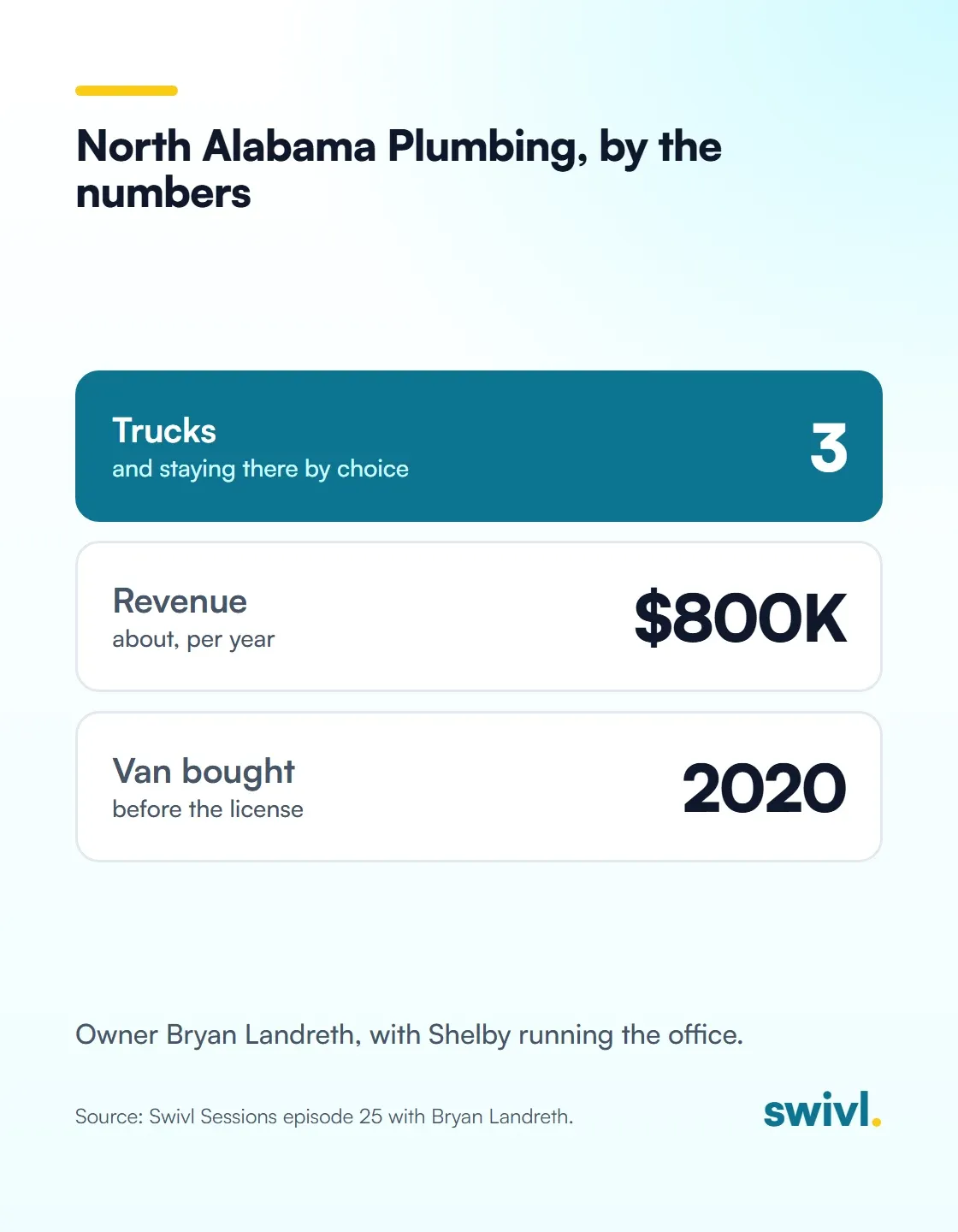
Table of Contents
Share this article
Grow past one truck by getting the office off your plate, hiring for attitude before skill, and keeping steady work coming in. Bryan Landreth of North Alabama Plumbing went from one van in 2020 to three trucks and about $800,000 a year, then chose to stop there. Bigger isn't the only goal.

Bryan Landreth runs North Alabama Plumbing in Huntsville, Alabama. He started it in 2020 with one van. Today it's three plumbers on the road, his wife Shelby running the office, and about $800,000 a year in revenue. He sat down with us on Swivl Sessions to talk about how he got there.
I ran a plumbing company for a long time before building Swivl, and a lot of what Bryan said sounded familiar. Here's what I'd pull out of it for any one-truck owner thinking about a second.
How did Bryan Landreth go from apprentice to owner?
He went straight from high school into the trade. He'd just become a dad, and college wasn't an option.
“I immediately knew I had to go straight into the workforce. College wasn't my path. Dad said, 'You got to buy them diapers, son.'”
He did a two-year apprenticeship, worked for local companies and moved up to lead technician quickly. Then he hit the ceiling. In his words, "I think I just lost my rings on my ladder. I think I just hit the peak of where I'm at and if I want to have more rings on my ladder, I got to jump ship."
So in 2020 he jumped, and he did it in an order most people wouldn't recommend: "I actually bought the van before achieving my license. And then my wife's like, 'All right, it's time to buckle up, get the show on the road.'"

What changes when a plumbing shop adds a second truck?
With one truck, you are the business. You answer the phone, write the estimate, do the work, send the invoice and chase the money. With two, somebody else is in a truck you're paying for, and you can't be in both places.
Three things have to change, and Bryan's shop shows all three:
- Someone has to run the office. Bryan's wife Shelby handles it. If the person on the phone is also the person under the sink, calls get missed and invoices go out late.
- The work has to be steady. Bryan built a relationship with a restoration company that brings in around $250,000 a year. One reliable source of work like that pays for a truck.
- The schedule has to be visible. The office needs to see who's where, and the techs need the job details on their phone, not in your head.
He also kept the hours sane. North Alabama Plumbing runs 9 to 5, rotates Saturday on-call, and doesn't work Sundays. That's a choice, and it's part of why he still likes the work.
Who should your first plumber hire be?
Bryan's advice on hiring is to hire for attitude: find people who care about the work, and don't lower the bar to keep a bad fit around. Good people are hard to find in the trades, and turnover comes with it.
I learned that one the hard way. My first real plumber hire, as opposed to drain cleaning, believed he was the company, and that without him we were nothing. He did bring in money, just not the multiple he thought. I'd see that same attitude at least five more times over the next 15 years.
What I got wrong was keeping him too long. I was looking at the revenue he brought in and lost sight of what he was doing to everyone else, because frankly he was a jerk to work with. It cost us a couple of steps backward with the rest of the crew and with a couple of customers, and that was worth far more than his extra sales.
The lesson I learned: hire for honesty and integrity, every hire, not just the first. It's hard to gauge in an interview, but it matters more than the sales number.
Swivl Sessions episode 25 with Bryan Landreth, owner of North Alabama Plumbing in Huntsville. He covers his apprenticeship, buying the van before his master license, wasted marketing spend and a Google suspension, the hunt for good plumbers, why service work holds up in a recession, and staying at three trucks. Jump to hiring at 15:00 or staying at 3 trucks at 24:00.
Do you have to keep growing past three trucks?
No. Bryan stays at three trucks by choice. His advice is to know your limits and not feel pressured to grow past your comfort zone, and to make room for family.
I think that gets said too rarely. More trucks means more payroll to make, more people to manage and more ways for a bad month to hurt. A three-truck shop that runs 9 to 5 and pays its people on time is a good business.
He also mixes his work on purpose, with service calls, bathroom remodels, restoration and light commercial. His reason is simple:
“When the economy crashes, nobody's going to care about how their tile looks... but as soon as their toilet quits working, you're getting a call.”
For more on the bottlenecks that show up as you grow, read scaling a plumbing business past its operational bottlenecks and how cost-plus pricing changed one plumbing business.
What should software cost as you add trucks?
This is where a lot of shops get squeezed. Many field service tools charge per user, so every plumber you hire raises the software bill too. Bryan has used Housecall Pro since day one, and it's a capable tool. Its Basic plan includes scheduling, estimates, invoicing, a price book and job costing, and Essentials adds routes and flat-rate pricing for bigger teams.
Here's what software costs a three-plumber shop on monthly billing, from each company's pricing page today:

- Housecall Pro: Basic is $79 a month for one user. Essentials is $189 a month, or $149 billed annually, with 5 users. (pricing, checked October 7, 2026)
- Jobber: Core is $49 a month with no commitment for one user, plus $29 a month per added user, so $107 for three. Paid annually, it's $87. (pricing, checked October 7, 2026)
- Swivl: Starter is $0 a month and Growth is $49, both with unlimited users. There's no per-seat or per-technician charge on any plan, and no contract. (pricing, checked October 7, 2026)
To be straight about our side: Swivl's AI features aren't free. The AI Estimator is about 60 credits an estimate, GPS is 5 credits an hour per tech while they're clocked in, and text reminders are a credit each. Starter includes 250 credits a month and Growth includes 1,500. Scheduling, estimates you write yourself, invoices and the mobile app for the whole crew cost nothing on any plan.
Matt Navin, who runs AAA Rooter in Berlin, Connecticut, put the small-shop math plainly on his Swivl Sessions episode:
“I'm a small business. I can't afford to spend a thousand dollars a month in order to have a system that works for me.”
A 44-second clip with Matt Navin, who runs AAA Rooter, a plumbing business in Berlin, Connecticut, and uses Swivl's free plan. He talks about what happened when he needed help he wasn't paying for.
If you're comparing options for your shop, our guide to plumbing business software goes deeper.
Frequently asked questions
When should a plumber add a second truck?
When you have steady work you can't get to and someone to run the office. Bryan Landreth's shop leaned on a restoration company relationship worth about $250,000 a year and his wife Shelby running the office.
How much revenue can a three-truck plumbing company make?
North Alabama Plumbing reports about $800,000 a year with three trucks, doing residential service, remodels, restoration and light commercial work. Your market and mix will change that number.
What should I look for in my first plumber hire?
Attitude and integrity first. Skills can be taught. A high producer who drags down the rest of the crew or upsets customers costs more than the extra sales are worth.
Does plumbing software charge per technician?
Many tools do. Jobber charges $29 a month per added user, and Housecall Pro plans include a set number of users. Swivl has no per-seat or per-technician charge on any plan, including the $0 Starter plan.
Do I have to keep growing to be successful?
No. Bryan Landreth stays at three trucks by choice, runs 9 to 5 with rotating Saturday on-call, and takes Sundays off. A profitable shop that fits your life is a good outcome.
Free to start. No contract. No sales call.
Start freeReady to transform your business?Transform your business
Join thousands of contractors already growing with Swivl's AI-powered platform.