
Local SEO for Plumbers: How to Get Found and Booked in Your Town in 2026
A plumber-specific local SEO playbook: win the map pack, stack reviews, build a fast plumbing site, and turn plumber near me searches into booked jobs, without a $5,000 agency.

Jeremy Edgar
Published Jul 14, 2026
Last updated Aug 12, 2026
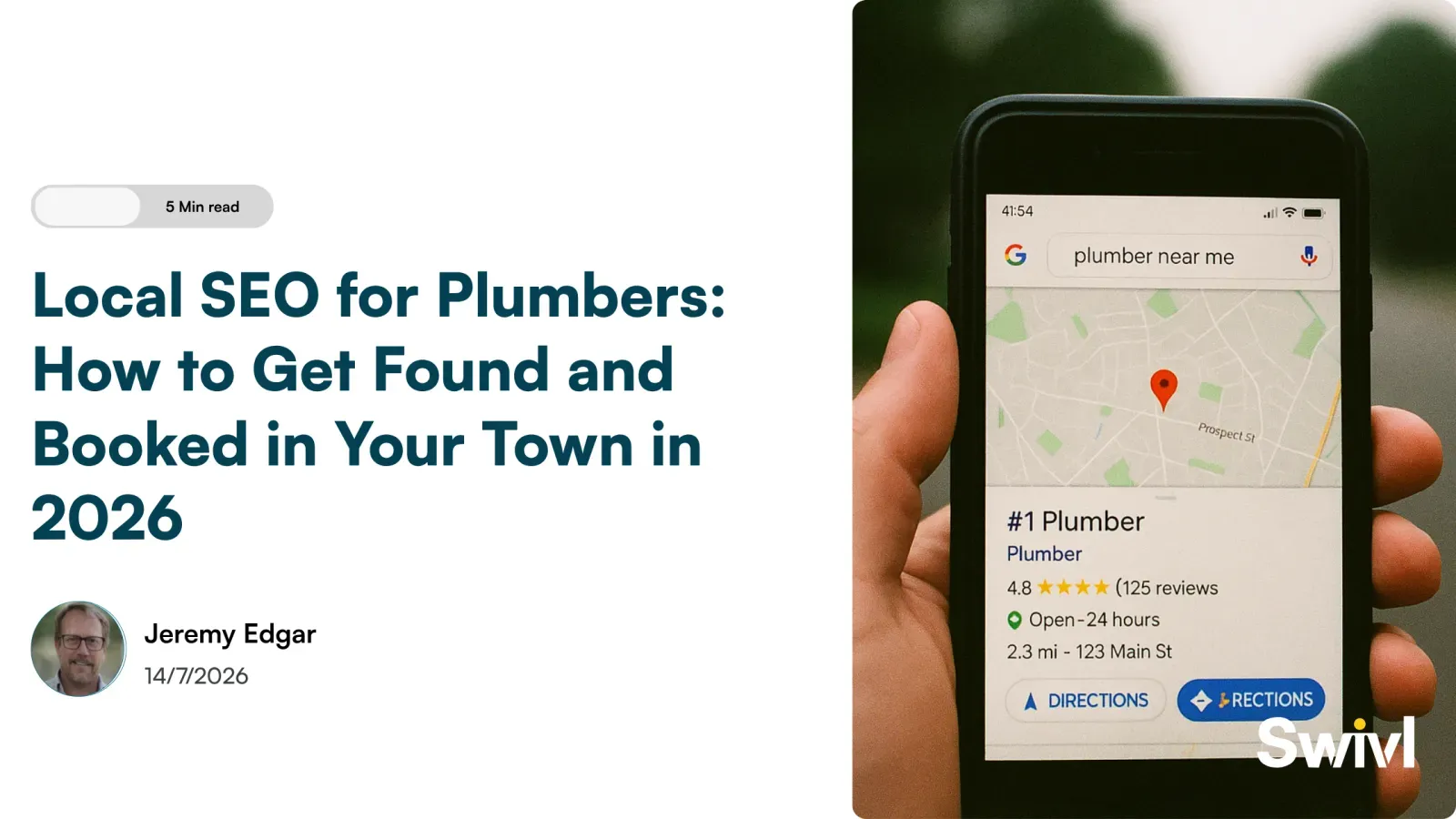
Table of Contents
Share this article
When someone's water heater dies or a pipe bursts under the kitchen sink, they do not ask a friend for a referral. They grab their phone, type "plumber near me" or "emergency plumber" plus their town, and call one of the first names Google shows them. That search happens thousands of times a day in every market in the country, and it is the single biggest source of new plumbing work there is.
The plumbers winning those calls are not better at pipe than you are. They are just easier to find. Local SEO is how you become one of the first names on that screen. This is a plumber-specific playbook: what local SEO actually means for a plumbing business, the handful of levers that move you up the map, and how to make sure the calls you earn turn into booked jobs instead of voicemails, without writing a $5,000 check to an agency.
For the broader picture across every trade, see our guides to SEO for contractors and local SEO for contractors. This one goes deep on plumbing.
Why local SEO is the whole ballgame for plumbers
Plumbing is one of the most search-driven trades there is, and it is different from a lot of businesses in three ways that make local SEO decisive:
- The searches are urgent. A clogged main or a flooding bathroom is a right-now problem. People do not shop around for a week. They call fast, and they call whoever is at the top.
- There is almost no brand loyalty. Nobody has a plumber's name memorized. They search the service ("drain cleaning," "water heater repair") plus "near me." That means the winner is decided on the search results page, not on reputation people carry in their heads.
- It is intensely local. You cannot serve a customer 90 miles away. Ranking in the next county over does you no good. All that matters is showing up for people inside the towns you actually cover.
Put those together and the takeaway is simple: for a plumber, being on the first screen of a local search is not a nice-to-have marketing project. It is where the majority of your new customers decide who to call.
Where plumbers show up (and the two places to win)
Google answers a "plumber near me" search in two spots, and you want both:
- The map pack. The little map with three business listings pinned to the top of local searches. This is the most valuable real estate for a plumber, because urgent callers look there first and rarely scroll past it.
- The regular links below the map, where your website competes on content and trust.
Everything below is about earning your place in those two spots. And here is the encouraging part: in most towns the bar is embarrassingly low. Half the plumbers in your area have an unclaimed Google listing and a website that has not been touched in five years. You do not have to be perfect. You have to be present, complete, and credible, and most of your competitors are not.
The four levers that get a plumber found
1. Your Google Business Profile: the biggest free lever
If you do one thing this week, do this. Your Google Business Profile is the free listing that powers the map pack, and for a plumber it is the highest-return move in local SEO, period. Claim it, verify it, and fill in everything.
A few things matter more for plumbers specifically:
- Categories. Set your primary category to "Plumber," then add the specific ones that fit: drain cleaning service, water heater supplier, septic system service, and so on. Google uses these to decide which searches you are relevant for. If you do sewer work and your profile does not say so, you will not show up for sewer searches.
- Service area. List the actual towns and zip codes you cover. Distance from the searcher is a ranking factor, so an accurate, complete service area helps you appear across your whole territory instead of just your home base.
- Emergency and hours. If you offer 24/7 or after-hours service, say it clearly. A big share of plumbing searches happen at night and on weekends, exactly when a lot of listings look closed.
- Photos. Real photos of real jobs, trucks, and your team beat stock images. Add them regularly. An active profile out-ranks a stale one.
A complete, active profile with the right categories and steady activity will out-rank a half-finished competitor every time.
2. Reviews: they rank you and they close the sale
Reviews do double duty for plumbers. They are one of the strongest map-pack ranking signals, and they are what a stressed homeowner reads before letting a stranger into their house during a crisis. The trust bar is higher for plumbing than for almost any trade, because you are asking someone to trust you inside their home with water pouring, so review volume and recency carry real weight.
A plumber with 80 reviews at 4.8 stars beats one with 6 reviews at 5.0 on both counts: Google ranks the first one higher, and the customer trusts it more.
The mistake nearly every owner makes is not asking. The Saturday water-heater job that went perfectly is the review you never got because you were already on the next call. Build the habit into the workflow: every completed job ends with a text asking for a Google review, link included. The tools that fire that request automatically the moment a job is marked done quietly compound your ranking and your reputation at the same time, with no extra effort from you.
3. A fast, plumber-specific website (and the agency trap)
Your Business Profile gets you into the map pack. Your website is what backs it up and wins the blue-link searches. For a plumber it needs to load fast, work on a phone (that is where nearly all your traffic is, often from someone standing in a flooded bathroom), clearly state your trade and the towns you serve, and make it dead simple to call or book.
This is where a lot of plumbers get taken. A digital agency will charge $2,000 to $5,000 and take three to six weeks to build a site, then bill you again every time you need to change your hours or add a service. Most of what they hand over is a good-looking brochure that never actually books a job.
You do not need that anymore. With an AI website builder made for service businesses, you can buy a domain and go live in under 15 minutes: a fast, mobile, SEO-ready plumbing site with booking built in, free to start, and yours to edit whenever you want. The website stopped being the expensive part of getting found. It is table stakes now.
4. Service and city pages: telling Google exactly what and where
Once you have a site, the content that ranks for a plumber is simple and specific: a page for each core service, and pages for the main towns you cover. A dedicated "water heater repair in [city]" page beats a single vague "Services" page, because it matches exactly what people type. Do that for your money services (drain cleaning, water heater, sewer and repipe, emergency plumbing) across the towns you serve.
You do not need a blog full of filler. You need clear service-and-city pages that name what you do and where you do it, backed by the profile and reviews above.
Citations and listings: the layer most plumbers skip
Your Business Profile is one listing. A citation is any other place on the web that prints your business name, address and phone number: Yelp, Bing Places, Apple Business Connect, Facebook, Nextdoor, the BBB, your chamber of commerce, and the plumbing and home-services directories. Google reads those as corroboration. When twenty sites all say the same name, the same address and the same phone number, Google is more confident your business is real and where you say it is, and that confidence is a map-pack ranking factor.
The reason this matters more for plumbers than for most trades is what breaks it. Two things go wrong constantly in this business: you change your phone number (a new tracking line, a switch to a call service, a second truck getting its own number), or you move and your service area shifts. The moment that happens, every old listing is quietly telling Google something different from your Business Profile, and your map-pack position softens without any obvious cause.
Do these by hand, in this order, before you pay anyone anything:
- Bing Places and Apple Business Connect. Free, ten minutes each, and they are the two that actually send a plumber calls outside Google. Apple Maps is what gets used in CarPlay.
- Yelp, Facebook and Nextdoor. Free. Nextdoor in particular punches above its weight for home services because it is where neighbours ask for a plumber recommendation by name.
- The data aggregators and the big directories. Angi, Thumbtack, the BBB, HomeAdvisor. Claim them even if you never intend to buy leads from them, because they rank and they carry your NAP.
- One spreadsheet. Business name exactly as it appears on your Business Profile, address, phone, hours, website. Every listing gets that exact string. "St." on one and "Street" on another is the kind of mismatch that costs you nothing to fix and something to leave.
What listings management actually costs
Search "plumber citation service" and you will be quoted three very different things. Here is what they really run, read off the vendors' own live pricing pages: BrightLocal sells citations at $2 per citation (bulk credits; $3.20 a site otherwise) and a fully managed local SEO service at $1,299 a month. Moz Local is a subscription that keeps your listings synced: $20 a month on Lite, $30 on Preferred, $33 on Elite, cheaper billed yearly. Whitespark's citation finder starts at $33 a month billed annually, and it is a research tool, not a submission service.
Now the arithmetic nobody puts on a plumber SEO page. A single-location plumbing shop needs roughly thirty core citations. Built once at $2 each that is $60, one time. The same coverage on a sync subscription is $20 a month, so $240 in year one and $240 every year after. The managed retainer is $1,299 a month, or $15,588 a year: 260 times the one-time build.
The honest verdict: citations are a build-once job with a maintenance tail, not a permanent subscription need. The one-time build is the right buy for almost every plumbing shop. A sync subscription only earns its $240 a year in the specific case where your NAP genuinely changes, which for most shops is once every few years, and on the month it does change you can subscribe, push the update everywhere, and cancel. The $1,299 retainer is priced for agencies managing many locations, not for a two-truck shop.
And to be straight about it, because we sell software and this is the part vendors skip: Swivl does not do citation or listings management. There is no listings sync in the platform and we are not going to pretend otherwise. Use the tools above for that layer. What we cover is the layer after it, which is the website the citations point at and the phone call the ranking produces.
Rank for drain cleaning, not just for "plumber"
One more thing the citation work sets up. "Plumber near me" is the hardest phrase in your market and every shop in town is aimed at it. The searches that are genuinely winnable are the service-level ones: drain cleaning, sewer line, water heater replacement, repipe, sump pump. Drain cleaning is the single highest-volume repeat service most plumbing shops run, and it is a materially easier ranking target than the generic head.
Two moves and it is done. First, add each of those as a service inside your Google Business Profile, not just as a category, because Google matches the service list against the query. Second, give each one a real page on your site rather than a bullet on a single "Services" page. A shop that ranks in the map pack for "drain cleaning" in three surrounding towns will out-earn one sitting at position four for "plumber," because the drain-cleaning searcher already knows what they need and is calling the first credible result.
What plumber SEO services cost, and what you actually get
At some point a company will call you, or you will search "SEO services for plumbers," and get pitched. Three genuinely different things are sold under that one name, and knowing which one you are being offered is most of the decision:
- Tools. $20 to $50 a month. Moz Local, BrightLocal, Whitespark. They show you where you rank and keep listings in sync. You still do the work, and for a single-location plumber this tier is usually enough.
- Managed local SEO. Several hundred to $1,299 a month. Someone else runs the profile, the citations, the posts and the reporting. This can be a fair deal if they are genuinely doing it, and the way you find out is to ask for the deliverable list in writing and check month two against it.
- Link building, guest posts and "authority" packages. Usually a few hundred a month, and this is the tier to be careful with. See below.
On that third tier, the plain fact: paying for links is against Google's own rules. Its spam policies list under link spam "buying or selling links for ranking purposes," and name explicitly "advertorial or native advertising where payment is received for articles that include links that pass ranking credit, or links with optimized anchor text in articles, guest posts, or press releases distributed on other sites." A package of city-page guest posts for a plumbing site is that, described precisely. It may work for a while. It is the shop's own domain carrying the risk, not the vendor's, and when it stops working you are the one starting over.
For a local plumbing business the honest ranking factors are not link packages anyway: they are a complete and active Business Profile, review volume and recency, consistent citations, a fast site, and real service and city pages. Those are the five things above, none of them cost $500 a month, and all of them are things you can verify were actually done.
The same applies to us: Swivl is not an SEO agency and does not sell an SEO service. Nobody here is going to run your citations or your Business Profile. What the platform does is the part that turns a ranking into revenue: the site that ranks, the booking on it, and answering the call when it comes.
Getting found is only half of it: catch the call
Here is the leak that wastes more plumber SEO effort than bad rankings ever do. You climb into the map pack, the phone finally rings at 8pm with a burst-pipe emergency, and the call goes to voicemail because you are under a sink across town. The homeowner does not leave a message. They call the next plumber on the list. You did the hard work of getting found and handed the job away in the last ten seconds.
Local SEO wins the click. What happens next decides whether it becomes money:
- Answer every call. After-hours and mid-job calls are exactly when plumbing emergencies happen, and a panicked caller will not wait on hold or leave a voicemail. An answering service or AI receptionist that picks up and books the job means the lead you earned does not walk.
- Let them book without calling. A booking widget on your site captures the homeowner who would rather tap than dial at 11pm.
- Quote fast. For bigger work like a repipe or a water-heater swap, the plumber who sends a clean written price first usually wins, even at a slightly higher number. On-site estimating turns interest into a signed job before a competitor calls back.
- Own the lead instead of renting it. Ranking on Google means the customer found you, so you keep 100% of that revenue. Compare that to buying the same lead from Angi or Thumbtack, shared with three other plumbers who are all racing to call it first. That is the whole case for owning your lead flow rather than renting it.
A plumbing software platform that ties this together puts your website, booking, calls, quotes, and scheduling in one place, which is what turns "found on Google" into "paid in the bank."
A worked example: from page two to the map pack
Take a two-truck plumbing shop that did solid work but was basically invisible online: an unclaimed Google listing, a slow website with one generic "Services" page, and 7 reviews. They were stuck on the second page of results for "plumber near me," which for practical purposes means they did not exist.
They fixed it in order, no ad budget and no agency. They claimed the Business Profile and filled it out: primary category Plumber, added drain cleaning and water heater categories, listed all nine towns they serve, flagged 24/7 emergency service, and posted real job photos. They rebuilt the site in an afternoon into a fast, mobile site with a page for each service and each town, plus a booking button and click-to-call up top. They started texting every finished customer a review link and climbed from 7 reviews to 50 over a couple of months. And they turned on an AI receptionist so the after-hours emergency calls stopped rolling to voicemail.
Within a couple of months they were surfacing in the local map pack for their core searches, and the emergency calls they used to miss were getting answered and booked. The work was always good. They just became findable, trusted, and reachable, in that order.
The bottom line
Local SEO for plumbers comes down to five moves: claim and complete your Google Business Profile with the right categories and service area, stack up real reviews, put up a fast website that names your services and towns, add clear service-and-city pages, and (the part everyone forgets) actually catch the calls it sends you. None of it requires being a marketing expert or cutting a big check to an agency. It requires showing up where your competitors are asleep.
That is exactly what Swivl is built to do for plumbers: an AI website builder that gets you live and SEO-ready in minutes with a custom domain you can link, Reviews and Ratings and online service booking (both included on the free Starter plan, no credit card), and quotes, scheduling and payments in one place with unlimited users on every plan. The AI receptionist that answers the 8pm burst-pipe call is on the Scale Pro and Organization plans, metered at 10 credits a minute, so price that one deliberately rather than assuming it comes with the free tier.
The plumbers winning the "near me" search are not spending more. They just made themselves easy to find and easy to hire.
Start free: build your plumbing site and get found →
Related reading: SEO for contractors: the full playbook, plumbing business software: how to choose, and how to stop missing customer calls. External: Google's own guide to improving your Business Profile ranking (open in a new tab).
Ready to transform your business?Transform your business
Join thousands of contractors already growing with Swivl's AI-powered platform.