
How Home Service Business Owners Lose Strategic Direction And How Systems Get Them Back
You are not just busy, you are lost. Learn why hacking through the daily brush is costing you the path to profitability.

Jonathan Tyson
Published Feb 24, 2026
Last updated Aug 28, 2026
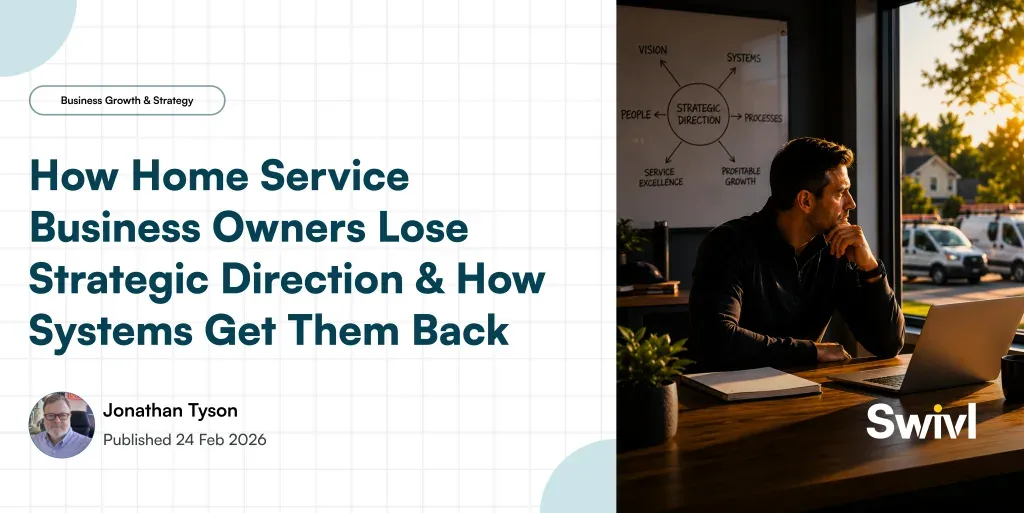
Table of Contents
Share this article
How Home Service Business Owners Lose Strategic Direction And How Systems Get Them Back
With GPS in every pocket and real-time maps on every dashboard, it is nearly impossible to get physically lost today. But most home service business owners will tell you that a different kind of lost, the operational, strategic kind, is easier to stumble into than ever. One day you are the person charting the path forward, setting the vision, calling the shots. The next, you realize you have been staring at the same patch of dense undergrowth for months: emails, scheduling tangles, missed follow-ups, manual invoices, and fires you never saw coming.
You are not just busy. You are lost in the operations of your own business, burning energy just to stay in place, too deep in the thicket to see the forest. And the longer that goes on, the harder it becomes to find your way back.
Why Home Service Business Owners Drift Off Course
The drift rarely starts with a single bad decision. It accumulates quietly, in the absence of defined priorities, documented processes, and reliable data to guide the calls you make every day. Without those guardrails, every issue feels equally urgent. Long-term planning gets pushed to "when things slow down," but things never do, because the business has been trained to depend on the owner's constant presence.
Opportunities to delegate feel risky. Investments in field service management software feel premature. Stepping back to think feels almost irresponsible when there is work to be done right now. So the cycle continues: reactive decisions, short-term fixes, and the quiet frustration of knowing the business could be doing more, if only there were time and space to actually lead it.
Across Swivl Sessions, our podcast featuring real field service operators, this pattern comes up again and again. Owners who built their businesses from nothing describe the same turning point: not when they worked harder, but when they stopped surviving and started leading differently.
The Trailblazer Trap: When Expertise Becomes a Bottleneck
One of the primary reasons home service business owners stay stuck is what could be called the trailblazer trap: the belief that because you carved the first path, you are the only one who can keep cutting it. What starts as earned confidence in knowing your trade better than anyone else slowly becomes role entrapment. You are no longer just the owner; you are the lead technician, the emergency dispatcher, the payment chaser, and the one who handles every escalation.
The business stops being something you lead and starts becoming something you carry. Mile after exhausting mile, the weight compounds. And because your identity gets tangled up in the grind, when progress stalls, it does not feel like a process failure. It feels personal.
The pressure to handle everything personally creates a mental fog that makes it harder to see alternative routes. Instead of climbing to higher ground to survey where to go next, you stay deep in the brush, swinging at vines, putting out fires, and never quite getting ahead. The path forward requires elevation, not more effort.
The Hidden Cost of Staying Busy Without a Direction
There is a dangerous illusion in field service: motion equals progress. A full calendar, a ringing phone, and a crew on the road all feel like proof that the business is healthy. But without intentional direction, that activity is just expensive busyness. The real cost shows up elsewhere: in missed partnerships, delayed growth decisions, neglected follow-up, and jobs that slip through because no system caught them.
Consider what poor scheduling visibility alone costs: double-booked crews, wasted drive time, and customers left waiting with no update. Or what manual invoicing costs in delayed cash flow and hours chasing down payments that should have been collected on-site. These are not minor inefficiencies. They are compounding drains that quietly eat into margin every single week.
What makes it worse is when an owner does not realize (or will not admit) that they are lost at all. Familiar routines create the illusion of control. Eventually, owners wake up feeling like strangers inside the company they built, unsure how they got there or how to steer it back. That moment is not caused by one bad decision. It is the accumulated cost of navigating without a clear destination for far too long.
What Getting Back on Course Actually Looks Like
The businesses that break free from constant firefighting are not the ones with the most capable technicians. They are the ones whose owners reclaimed the map. And in nearly every case, that shift started with putting the right systems in place, not working harder, but building an operational backbone that could carry the weight of day-to-day decisions without needing the owner in the middle of everything.
Automated scheduling and dispatch means jobs get booked, assigned, and confirmed without the owner acting as the switchboard. Automated invoicing and payments means cash comes in predictably instead of trickling in weeks after the work is done. And real-time reporting and analytics means you can actually see where the business stands: which jobs are profitable, which crews are most efficient, which services drive the most margin, all without a spreadsheet session at midnight.
When the operational layer runs on its own, the owner gets something priceless back: mental space. Not empty hours, but the ability to think ahead rather than just react. That is when strategy becomes possible again, when you can choose which jobs to prioritize, which customers to target, which service lines to grow.
Field Service Management Software as Your Business Compass
Think of field service management software the same way you think about GPS on a job site: not as a replacement for your expertise, but as the tool that makes sure your expertise is being applied in the right direction. A platform like Swivl centralizes your customer relationship management, job management, payments, and performance data into one place, so nothing falls through the cracks and everything is visible at a glance.
For home service businesses running HVAC, plumbing, electrical, cleaning, landscaping, or any other trade, that kind of operational clarity is not a luxury. It is the difference between building something sustainable and grinding through years of exhaustion without real growth to show for it.
When you trust the processes and let the platform carry the operational weight, you reclaim the headspace to think strategically instead of reactively. You move from putting out today's fires to designing tomorrow's growth. The shift is not about doing less work. It is about doing the work only an owner can do: setting direction, building the team, and deciding which paths are worth taking at all.
Signs Your Business Has Drifted And How to Course-Correct
If any of the following feel familiar, the drift has already started:
- You cannot leave the business for a day without something breaking down.
- Your scheduling is managed through texts, phone calls, or a paper calendar.
- Invoices go out days after the job is done and payments arrive weeks later.
- You have no real data on which services or customers are most profitable.
- Leads come in but follow-up is inconsistent, and you are not sure how many convert.
The course-correction does not require starting over. It requires replacing the manual, disconnected processes one by one with systems that run automatically, surface the right information at the right time, and free you from being the operational glue holding everything together.
If you are also dealing with missed calls costing you jobs, pairing field service management software with an AI receptionist ensures that no lead goes unanswered while you are on the job. And if inconsistent estimating is slowing down your close rate, the AI estimator produces accurate, professional quotes fast, removing the guesswork that stalls deals.
Stop Surviving. Start Leading.
Every home service business owner who has ever felt trapped in the daily grind built something worth saving. The problem is not the business. It is the absence of infrastructure that lets the business run without demanding your constant intervention. With the right field service management platform underneath you, the wilderness stops being a place of survival and becomes a landscape of real opportunity.
Swivl is a comprehensive home service business management platform built to automate the operational heavy lifting, from scheduling and dispatch to invoicing, payments, GPS tracking, and reporting, so you can step out of the brush and get back on the path to profitability. If you are ready to trade daily chaos for strategic control, you can start free and let Swivl clear your path.
Ready to transform your business?Transform your business
Join thousands of contractors already growing with Swivl's AI-powered platform.