
Local SEO for HVAC and AC Repair: Get Found When the AC Quits
A plain guide to local SEO for HVAC and AC repair companies: rank in the map pack for air conditioning repair searches, catch the call, and own your leads.

Jeremy Edgar
Published Jul 16, 2026
Last updated Aug 13, 2026
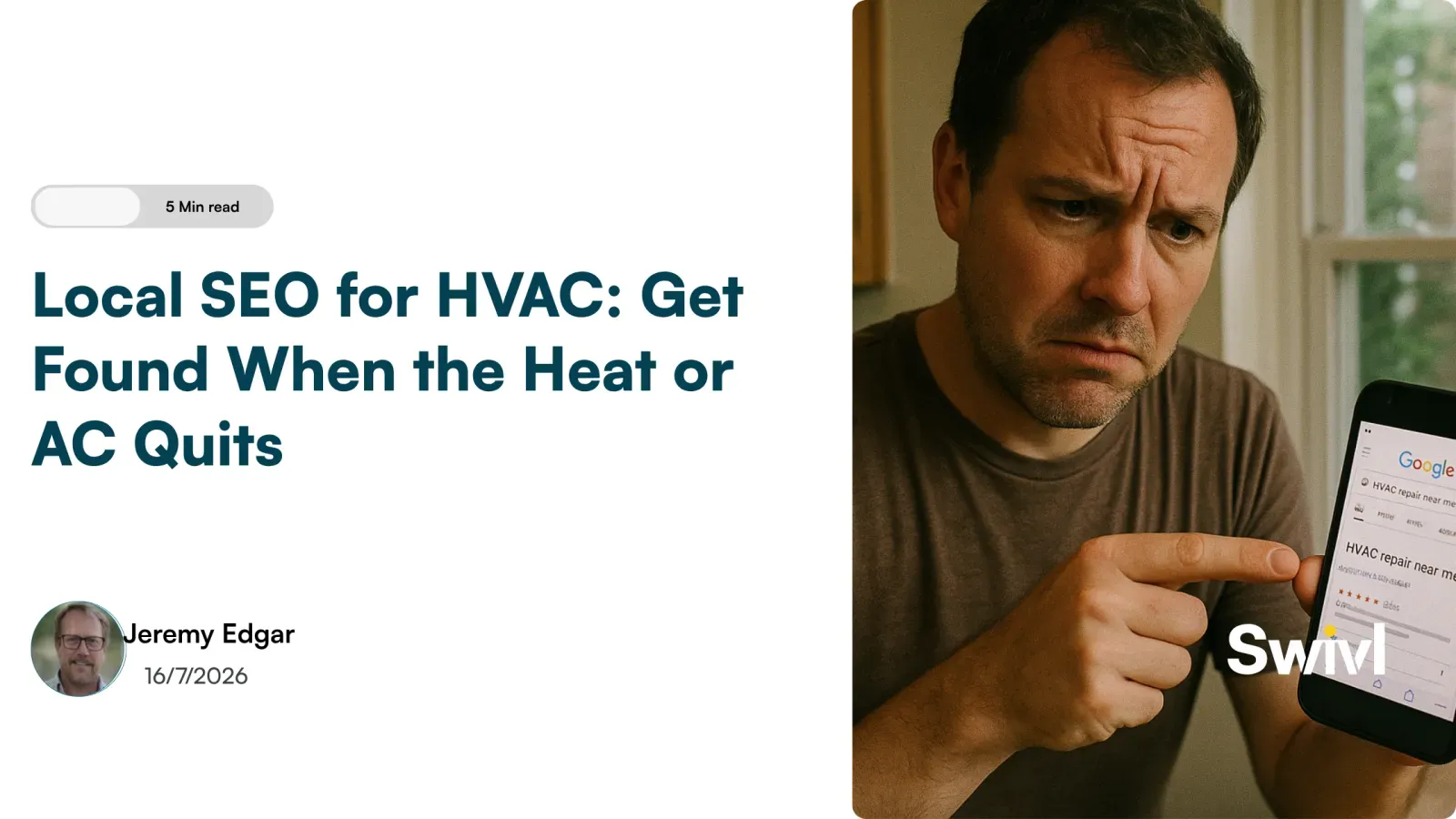
Table of Contents
Share this article
It is the first 90-degree day of the summer. Somewhere in your town, a homeowner's AC just stopped, the house is getting warmer by the hour, and they are standing in the kitchen with their phone typing "ac repair near me." In the next 30 seconds they will tap one of the first three companies Google shows them, and they will call. If your company is one of those three, you get the job. If it is not, you never existed for that customer.
That moment repeats hundreds of times across your service area every season: a dead furnace in January, a failing heat pump in a shoulder month, a maintenance search before the heat wave. Local SEO for HVAC is simply the work of making sure your company is the one that shows up at that moment. Get it right and you get a steady stream of jobs that cost you nothing per lead. Get it wrong and you are stuck paying $50 to $100 for the same customer through a lead marketplace.
This guide walks through exactly how HVAC local SEO works, what to do first, and how to catch and keep the calls it sends you.
Why local SEO decides who wins HVAC jobs
Every trade benefits from ranking locally, but HVAC has three things going for it that make local SEO the single highest-return marketing move you can make. For the cross-trade version of this playbook, see our guide to SEO for contractors. This one goes deep on heating and cooling.
First, HVAC demand is urgent and emotional. Nobody shops around for a week when the AC dies in July or the furnace quits in a cold snap. They want someone who can come today, and they trust Google to hand them a short list. Second, there is almost no brand loyalty in an emergency. The homeowner does not care whether they have heard of you. They care that you are close, that you have good reviews, and that you pick up the phone. Third, HVAC is intensely local. A customer 25 minutes away is worth more to you than one across the state, because your day is drive time plus wrench time. Google knows this, which is why it leans so hard on proximity and local signals for "near me" searches.
Put those together and the map pack (the three-business box with the map that sits at the top of local search results) is where HVAC jobs are won and lost. Ranking there is not about outspending a national brand. It is about a handful of specific, unglamorous moves that most of your competitors have not bothered to do.
The four moves that get an HVAC company found
1. Your Google Business Profile: the biggest free lever
Your Google Business Profile is the free listing that powers the map pack, and it is the highest-return thing you can touch this week. Claim it, verify it, and then fill in every field like your season depends on it, because it does.
For HVAC specifically, get these right: set your primary category to "HVAC contractor" and add the secondary categories that match the work you actually do (air conditioning contractor, furnace repair service, heating contractor, air conditioning repair service). Define your service area by the towns and zip codes you cover, not a fake address. Set your hours honestly and turn on the "open 24 hours" or emergency-service signals if you truly answer after-hours calls, because that is a ranking and trust factor for exactly the panicked searches you want. List your services (AC repair, furnace repair, heat pump installation, maintenance plans, indoor air quality) so Google can match you to specific searches. Add real photos of your trucks, your crew, and finished installs, and keep adding them. Answer the questions people post, and use Posts to push seasonal offers (a spring AC tune-up, a fall furnace check). Google rewards a profile that is active, and a stale one quietly slides down. If you want the official checklist, Google publishes a guide to optimizing your Business Profile.
2. Reviews: they rank you and they close the sale
Reviews do double duty. They are one of the strongest local ranking signals, and they are the thing a nervous homeowner reads before letting a stranger into their house to touch a $6,000 system. The trust bar for HVAC is higher than for a lot of trades, so this matters more, not less.
The move is simple and most shops skip it: ask every happy customer for a review, at the moment they are happiest. That is right after the AC blows cold again or the heat comes back on, not three weeks later in an email nobody opens. Send a direct link by text while the tech is still in the driveway. Respond to every review, good or bad, because a calm, professional reply to a complaint reassures the ten people reading it more than the complaint scares them. Volume and freshness both count, so make the ask a standing part of the job, not a once-a-quarter push.
3. A fast website that backs up the profile (and the agency trap)
Your Business Profile gets you into the map pack. Your website is what confirms to Google what you do and where, and what turns a click into a booked call. It does not need to be fancy. It needs to load fast on a phone, say clearly that you do HVAC and which towns you serve, show your phone number and a booking option on every screen, and prove you are legit with reviews, license info, and photos.
Here is where a lot of HVAC owners lose money: they hand this to an agency for $3,000 up front plus a monthly fee, wait six weeks, and end up with a slow brochure they cannot edit and do not own. You can stand up a fast, HVAC-specific site yourself in an afternoon with Swivl's AI website builder, keep control of it, and change your seasonal offer whenever you want. For the full argument on doing this yourself versus hiring out, see our guide to contractor website design.
4. Service and city pages: telling Google exactly what and where
Once you have a site, the content that ranks for an HVAC company is specific, not clever. Build a page for each core service and a page for each main town you serve: "AC repair in [City]," "furnace repair in [City]," "heat pump installation in [City]," "emergency HVAC in [City]." Each page should speak to that job in that place, not repeat a generic homepage.
The HVAC twist is timing. Demand swings hard with the season, and so does the competition for these searches. Get your AC pages written and indexed in early spring so they have time to rank before the first heat wave, and your heating pages up in early fall. A page you publish the week the heat wave hits is too late to help you this year. This is the same play plumbers use for their emergency searches, laid out in our guide to local SEO for plumbers; the structure carries over cleanly to heating and cooling.
Which Google Business Profile categories should an HVAC company pick?
Categories are the one setting on the profile that decides which searches you are even eligible for. Everything else on this list makes you rank better for searches you already qualify for. Categories decide which searches those are. Most heating and air companies set them once on the day they claim the profile, pick whatever sounded closest, and never look again, which is how a shop that does half its revenue in furnace work ends up invisible every October.
The categories to look for in the picker
Google does not publish the full list, so you find these by typing into the category box and taking the exact wording it offers. For a company that services and installs both sides of the system, these are the entries that matter:
- HVAC contractor. The primary category for almost every full-service shop. It covers the whole system and it is what the picker expects when you both install and repair.
- Air conditioning contractor. The install and replacement side of cooling. Use it if you sell and fit systems, not only fix them.
- Air conditioning repair service. The repair side. This is the one that lines up with a homeowner whose air conditioner quit this afternoon, which is the search you actually want.
- Heating contractor. The heating equivalent of the first one. Furnaces, boilers, heat pumps on the heating side.
- Furnace repair service. The specific one. If furnace work pays your winter, this belongs on the profile.
The furnace half is where most profiles quietly fail. "HVAC contractor" plus "Air conditioning repair service" reads to Google as a cooling company, so you compete hard in July and disappear in January. If heating is real revenue, Heating contractor and Furnace repair service have to be on there, and they have to be on there before the first cold snap, not during it. Categories do not rank you overnight any more than a new page does.
How many is too many
You are allowed a primary plus up to nine additional categories, and every "best categories" list on the internet will tell you to fill them. Google's own guideline says the opposite. Its guidelines for representing your business put it in one line: "Choose the fewest number of categories it takes to describe your overall core business."
The practical read for an HVAC shop: one primary, then two to four secondaries that describe work you would genuinely send a truck for. Adding "Plumber" because you replaced a shut-off valve once, or "General contractor" because it sounds bigger, makes the profile blurrier rather than broader, and a blurry profile competes with specialists who are not blurry. Pick what you do, drop what you do not, and revisit it once a year when your service mix changes.
Two things to check while you are in there. First, your service list is separate from your categories: the categories tell Google what kind of business you are, the services tell it what jobs you take. Fill both. Second, the picker's wording changes over time, so search the box for the words rather than trusting a screenshot from someone's blog post.
Getting found is only half the job: you have to catch the call
Local SEO does one thing: it makes the phone ring. If nobody answers, you paid for that ranking with your time and handed the job to the next company on the list. And HVAC calls come at the worst times, the after-hours no-heat call in January, the Saturday no-AC call in July, exactly when your team is on a job or asleep.
This is the leak that quietly cancels out good SEO. A missed call in HVAC is rarely a voicemail and a callback later; the homeowner is already dialing the next result. Swivl's AI receptionist answers every call, day or night, books the appointment, and texts you the details, so a 2 a.m. no-heat call becomes a booked morning job instead of a competitor's win. We break down why this matters so much for heating and cooling in our guide to an HVAC answering service, and the same logic applies to any answering service for contractors. Pair it with online booking so the customers who would rather tap than talk can lock in a slot themselves.
Own your leads, do not rent them
The whole point of local SEO is that the customers it brings you are yours. They found you, they called you, and you did not pay a marketplace a fee for the privilege. That is the opposite of Angi, Thumbtack, or Bark, where you pay per lead for a customer who got sent to four other companies at the same time and the price only climbs.
Owned channels (your Google Business Profile, your reviews, your ranking pages, and your own ads) build an asset that keeps working. Rented leads stop the second you stop paying. We lay out the full case in our guide to getting contractor leads you actually keep, and if you want the paid side done right, Swivl's lead management and ads tools keep your own campaigns feeding your own pipeline. For the wider marketing plan around all of this, see marketing for contractors.
What HVAC local SEO can and can't do (the honest version)
Local SEO is the best long-term deal in HVAC marketing, but it is not a switch you flip. Claiming and filling out your Business Profile can move you in a few weeks. Reviews and ranking pages compound over months. It is a build, not a buy.
It is also seasonal, which cuts both ways: your rankings and your call volume will swing with the weather, so plan your content ahead of the season rather than chasing it. And it cannot paper over a bad reputation or a phone nobody answers; if your reviews are thin or your calls go unanswered, more visibility just means more people bouncing to a competitor. While your organic presence is building, well-run local ads can bridge the gap and buy you the top of the page during peak season. Fix the foundation first, then let SEO carry the steady base and ads handle the surges.
A worked example: a three-tech HVAC shop before summer
Picture a three-tech shop that has always run on word of mouth. Its Google Business Profile is unclaimed, its website is a slow one-pager from 2019, and it has 11 reviews. Through spring it does the work: claims and fully fills out the profile with the right HVAC categories and service area, rebuilds a fast site with AC-repair and furnace-repair pages for its three main towns, starts texting a review link after every job, and turns on an AI receptionist so nothing rings out.
By the first heat wave the shop is showing up in the map pack for "ac repair near me" in two of its three towns, its review count has passed 40, and the after-hours calls that used to go to voicemail are now booked morning jobs. The owner did not spend a dollar per lead to make that happen. The jobs came from customers who searched, found the shop, and got a live answer. That is what local SEO for HVAC looks like when the four moves and the catch-the-call layer are all working together, run on top of a real HVAC business software so scheduling, dispatch, and invoicing keep up with the new volume.
The bottom line
Local SEO for HVAC comes down to a short list: claim and fully build out your Google Business Profile, stack up real reviews and respond to them, put up a fast site with service and city pages timed to the season, and make sure every call gets answered. Do those, own the leads they bring you instead of renting them, and you build a source of jobs that costs nothing per customer and keeps working season after season. For the bigger picture on running and growing the whole operation, start with our guide to starting, running, and growing an HVAC business.
Swivl gives HVAC owners the website, the lead tools, and the AI receptionist in one place, with unlimited users on every plan. The AI website builder and the estimator are included on the free Starter plan; the AI receptionist sits on Scale Pro at $149 a month and Organization at $299 a month, metered by the minute. Start free today and get found when the heat or the air conditioning quits.
Ready to transform your business?Transform your business
Join thousands of contractors already growing with Swivl's AI-powered platform.